Corporate Valuation, Oil & Gas

November 21, 2018

Haynesville's Gigantic Gas Resurgence Could Be A Winner In LNG Export Race

Ever since producers took some big financial beatings after prices plummeted a few years ago, the Haynesville Shale play has positioned itself for an economic resurgence. For those following natural gas production in the U.S., this should not come as a surprise. It has a lot going for it.

Haynesville’s Wells – Bigger, Faster, Stronger

Consider the following:

  • It’s a behemoth of a gas field that produces enormous wells. It’s been known for some time that the Haynesville has potential, but that is being realized further as more experience is developed among operators. For example, long lateral wells (some now stretch nearly two miles each) can produce up to 24 bcf of natural gas. Compared to the nearby Eagle Ford Shale, whose wells produce 12-15 bcf of natural gas, the Haynesville wells are big. In today’s low gas price environment, this matters quite a bit.
  • The formation is more naturally pressurized than many others. This means, among other things, that more gas is produced in the first year. This is important, considering how expensive it is to drill these wells, and in turn, it means higher rates of return for investors (since time can erode returns according to present value theory).
  • Breakeven prices have fallenAccording to Chesapeake, which has the largest acreage position in the Haynesville, breakeven prices are currently between $2.00–$2.25 mcf. Even with price differentials of about $0.60 to Henry Hub, this provides an opportunity for profitable wells. Two or three years ago, this was considered an improbability.
Investors have noticed. Amid the land rush for liquid plays such as the Permian Basin, some investors have quietly spent billions to reposition themselves in the Haynesville over the past few years at relatively low valuations. The most notable of which is Jerry Jones’ $620 million investment in Comstock Resources over the summer. Comstock has been one of the leading players in the basin for years and is confident that their experiences, amid a rough recent financial history, will propel them going forward. Lesser known private companies such as Aethon Energy and Indigo Natural Resources (which has contemplated going public) have also poured substantial investments into the play in the past few years.

LNG Exports – A New Proverbial Finish Line

That said, one of the vexing problems that the natural gas sector often has is getting the product to relevant markets. The current situation in the Permian Basin is a prime example. Even though gas production is there, it doesn’t matter much if it can’t easily and inexpensively get to where it’s needed. And while the Haynesville has had its own struggles in this area, there may be solutions on the horizon to provide some relief. This is where the Gulf Coast LNG export resurgence comes into the picture.

Currently, the ability to export LNG is relatively trivial. The continental U.S. has only two facilities operating with less than 4 bcf of capacity per day. That’s about to change. The Gulf Coast alone has nearly 8 bcf per day capacity under construction and another 6.8 bcf per day has been approved. Over 26 bcf per day has additionally been proposed.  Facilities are being proposed up and down the coast from Brownsville, Texas to Pascagoula, Mississippi.
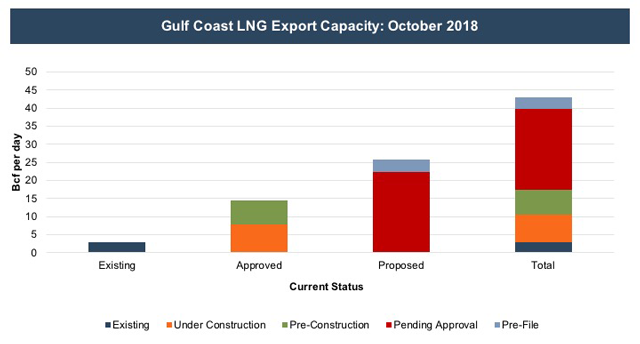
[caption id="attachment_23202" align="alignnone" width="640"]Source: Federal Regulatory Energy Commission[/caption]

Along with capacity, transportation is getting easier too. The widening of the Panama Canal has certainly helped. In addition, certain transit restrictions on LNG vessels were lifted just last month. Over the past two years, 372 LNG transits have passed through the canal; and incredibly, earlier this year three tankers crossed at the same time. This is incentivizing the investment and engineering race to get capacity built and shipped to foreign markets. Most recently, Germany initiated stepstoward installing an LNG import facility.

Haynesville’s Head Start – A Shorter And Cheaper Race To Run

In the race to chase efficiencies, the Haynesville’s proximity to the Gulf Coast provides a big opportunity for investors.

What are the options to service the strongly growing demand? There’s a plethora of potential gas sources in the U.S. to fit the bill. Currently, the largest supply is the Marcellus and Utica shales in Appalachia, and this would seem to be a natural fit except that there is a problem. Prices for gas in the region are far below Henry Hub prices. In addition, transportation costs tower above other plays due to the multi-state journey it needs to take to get to the Gulf Coast.  By the time the gas arrives at its destination, it would almost certainly lose money for producers. Margins are simply too tight right now in the gas business and efficiency is becoming increasingly critical.

In the race to chase efficiencies, the Haynesville’s proximity to the Gulf Coast provides a big opportunity for investors. At a recent conference, Tom Petrie, a leading energy investment banker, gave some estimates of transportation costs from proximate U.S. gas basins. Not surprisingly, the Haynesville was by far the cheapest at $0.25 per mcf.
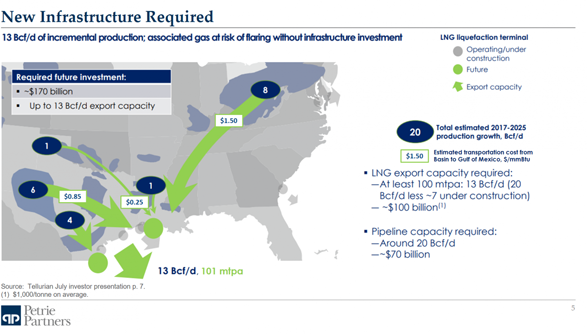
[caption id="attachment_23203" align="alignnone" width="587"]Source: Oil and Gas Investor, Petrie Partners[/caption]

In a business where the window for profitability is small, pennies per mcf matter a lot. Naturally this dynamic calls for more localized gas. Considering the Gulf Coast concentration of LNG facilities, the Haynesville, Eagle Ford and other nearby plays may have a leg up with proximity and infrastructure ability to get gas to facilities.

The Haynesville looks like it could have an international role to play in energy markets going forward. That is a golden opportunity to create value. As for the Marcellus and Utica shales in Appalachia, they might miss out on this one. It makes one wonder, why haven’t LNG applications shown up in Pennsylvania yet?
Originally appeared on Forbes.com.

Continue Reading

Mercer Capital Sponsors ASA Houston’s 2026 Energy Valuation Conference
Mercer Capital is pleased to serve as a Gold Sponsor of the 2026 Energy Valuation Conference, hosted by the Houston Chapter of the American Society of Appraisers. The conference will take place on Thursday, May 14, 2026, at The Briar Club in Houston, Texas, with both in-person attendance and live webcast options available. Bryce Erickson, ASA, MRICS; J. David Smith, CFA, ASA; and Andrew B. Frew, ASA, ABV, will attend on behalf of Mercer Capital.Now in its 16th year, the Energy Valuation Conference brings together appraisers, accountants, financial analysts, petroleum engineers, and many other professionals working across the energy sector. The conference is designed as a multi-disciplinary forum addressing valuation techniques and issues across the energy industry, including upstream, midstream, downstream, renewables, power generation, tax, governance, and emerging market considerations.This year’s program will address a range of current valuation topics affecting the energy industry, including energy transition, transaction activity, capital markets, and valuation considerations across upstream, midstream, and downstream sectors.Bryce Erickson is a Managing Director at Mercer Capital and leads the firm’s energy industry practice. Since 1998, he has led approximately one thousand engagements across diverse purposes, including gift and estate tax planning, litigation support, mergers and acquisitions, buyouts, buy-sell agreements, financial reporting, purchase price allocation, financing, and business planning. He regularly publishes on oil and gas industry topics in Mercer Capital’s Energy Valuation Insights blog. He is also a contributor to Forbes.com’s Energy sector.J. David Smith is a Senior Vice President at Mercer Capital and a senior member of the firm’s energy practice. He provides valuation services for tax planning, transactional purposes, and financial reporting. David is also a regular contributor to Mercer Capital’s Energy Valuation Insights blog.Andrew B. Frew is a Vice President at Mercer Capital and has nearly 25 years of business valuation experience. He has been involved with hundreds of valuation and related engagements across numerous industries and values businesses and business interests for gift and estate tax, charitable giving, buy/sell agreements, mergers and acquisitions, business succession and exit planning, and litigation support purposes. Andy also contributes regularly to Mercer Capital’s Energy Valuation Insights blog.Mercer Capital works with energy companies, mineral and royalty owners, oilfield services businesses, investors, attorneys, accountants, and other advisors on valuation and financial advisory matters. The firm provides business valuation, asset valuation, litigation support, transaction advisory, financial reporting valuation, and tax valuation services across the energy sector, helping clients address complex financial questions with clear, independent, and well-supported analysis.Mercer Capital looks forward to supporting the conference and connecting with energy valuation professionals and industry leaders in Houston. Additional information about the 2026 Energy Valuation Conference is available at https://energyvaluationconference.org/.For more information about Mercer Capital’s experience and expertise in the oil & gas sector, visit https://mercercapital.com/industries/energy-power/oil-gas/.
EP First Quarter 2026 Eagle Ford
E&P First Quarter 2026

Region Focus: Eagle Ford

Eagle Ford // The Eagle Ford exhibited modest production growth over the past year, broadly in line with other major basins, as output remained within a relatively narrow range. This stability reflects the basin’s maturity, with limited variability in production despite declining rig counts and continued capital discipline among operators.
Just Released: Q1 2026 Oil & Gas Industry Newsletter

Region Focus: Eagle Ford

The Eagle Ford exhibited modest production growth over the past year, broadly in line with other major basins, as output remained within a relatively narrow range. This stability reflects the basin’s maturity, with limited variability in production despite declining rig counts and continued capital discipline among operators.

Cart

Your cart is empty