Corporate Valuation, Oil & Gas
shutterstock_264566771.jpg

January 19, 2021

2021 Is Still an Optimal Time for Gifting Interests in E&P Companies

Factors That Led to a Rush of Estate Planning Activity in 2020 Largely Remain

December was a busy month at Mercer Capital, and at business valuation firms across the country.  Clients sought to make gifts and perform other estate planning transactions ahead of year-end.  But the changing of the calendar does not mean that the window for gifting is over.  The factors that led to a rush of estate planning transaction activity during 2020 largely remain.  The combination of depressed E&P valuations, the potential for future tax changes, and the ability to utilize minority interest and marketability discounts are still present in 2021.

Depressed E&P Valuations

2020 was a difficult year for many companies, though the pain was acute for E&P companies that were faced with unprecedented demand destruction that led to negative oil prices.  Recovery appears to be taking hold, but the pace is uncertain and some changes in commuting and business travel habits might be permanent.

While E&P company values (as proxied by the SPDR S&P Oil & Gas Exploration & Production ETF) have recovered from their lows in March, the index remains down year-over-year, having declined 38% during 2020.

[caption id="attachment_35371" align="aligncenter" width="645"]
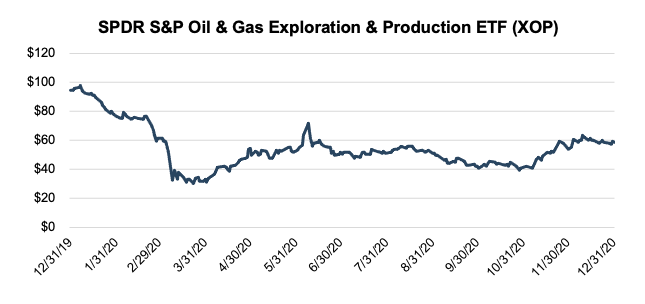
Source: Capital IQ[/caption] The recent spate of E&P bankruptcies also is indicative of a challenging operating environment and reduced equity valuations.  There are exceptions with assets and situations of highly economic Tier 1 production, and/or acreage that can maintain or have proportionally small value decreases during this downturn, but most E&P companies have suffered alongside commodity prices. While unpleasant from a net worth perspective, this (hopefully temporary) reduction in value can be a boon for estate planning purposes, allowing taxpayers to gift larger interests, while utilizing less of their gift & estate tax exemption (or paying less in taxes on the gifted interest).

Potential for Future Tax Changes

President-elect Biden’s tax plan calls for some major changes to the current gift & estate tax regime.  Most notably, the estate tax exemption could be reduced from today’s $11.7 million (unified) to $3.5 million (estate) and $1.0 million (gift), and the tax rate could increase from 40% to 45%.  The prospects for tax reform likely increased after Georgia’s Senate run-off elections on January 5th put the Democrats in control of both houses of Congress.

While new tax legislation could potentially be made retroactive to January 1, many tax policy experts see that as unlikely.  Mercer Capital’s Atticus Frank has a great blog post with additional reading for anyone interested in estate planning for 2021.

Consider taking advantage of the current gift & estate tax exemptions in 2021 before they potentially go away.

Minority Interest and Marketability Discounts

By gifting minority interests to heirs, taxpayers can potentially utilize minority interest and marketability discounts to reduce the value of the gifted interest and ease gift & estate tax burdens.  These discounts are highly dependent on facts and circumstances surrounding the subject interest.  Mercer Capital has successfully defended its minority interest and marketability discounts to the IRS and in other litigated contexts.

By gifting minority interests, one does not only benefit from the application of minority interest and marketability discounts during the gifting process.  If done as a part of a thoughtfully executed estate planning strategy, gifting can result in a non-controlling ownership interest in an estate, allowing for the potential application of discounts for estate tax purposes as well.

Mercer Capital’s Travis Harms has an insightful blog post about this issue.  In the post, he runs hypothetical math showing the difference in potential tax liabilities under various gifting scenarios.  A thoughtful gifting strategy as part of a broader estate plan can have a significant impact on the proceeds heirs receive from an estate.

Conclusion

Despite what one might think, the window for gifting transactions has not closed.  Mercer Capital provides valuation and other financial advisory services to families seeking to optimize their estate plans.  Give one of our professionals a call to discuss how we can help you in the current environment.

Continue Reading

January 2026 | Making Buy-Sell Agreements Work: Valuation Mechanisms and Drafting Pitfalls
Value Matters® January 2026

Making Buy-Sell Agreements Work: Valuation Mechanisms and Drafting Pitfalls

Executive SummaryBuy-sell agreements are a cornerstone of planning for closely held businesses and family enterprises. Advisors spend significant time addressing ownership transitions, funding mechanisms, and tax considerations. Yet despite their importance, valuation provisions in buy-sell agreements are often treated as secondary drafting issues. Too often, they are boilerplate clauses that receive far less scrutiny than they deserve. When buy-sell agreements fail, valuation provisions are often the root cause.This article is the first in a two-part series examining how buy-sell agreements function in practice and why so many fall short of their intended purpose. Part I focuses on the valuation mechanisms commonly used in buy-sell agreements – fixed price, formula pricing, and appraisal-based processes – and explains the structural weaknesses that often undermine them. Drawing on our extensive valuation experience, we offer a practical framework for designing valuation provisions that are more likely to produce fair, predictable, and workable outcomes when a triggering event occurs.Part II will address what is required for buy-sell agreement pricing to be used to fix the value for gift and estate tax matters, including the requirements of Internal Revenue Code §2703 and guidance from key court cases such as Estate of Huffman and Connelly. Together, these articles are intended to help estate planners move beyond theoretical drafting and toward buy-sell agreements that withstand both real-world and IRS scrutiny.Common Buy-Sell Valuation MechanismsMost buy-sell agreements fall into one of four categories based on how price is determined:Fixed priceFormula pricingMultiple appraiser processSingle appraiser processEach approach has perceived advantages, but each also carries structural weaknesses that estate planners should carefully evaluate.Fixed-Price AgreementsFixed-price buy-sell agreements establish a specific dollar value for the business or ownership interests based on the owners’ agreement at a point in time. Their appeal lies in simplicity. The price is clear, easily understood, and inexpensive to administer. In theory, fixed-price agreements encourage owners to revisit and reaffirm value periodically.In practice, however, fixed prices are rarely updated with sufficient frequency. As the business evolves, the fixed price may become materially understated, overstated, or – by coincidence – approximately correct. The fundamental problem is not the use of a fixed price, but the absence of a reliable and consistently followed process for updating it. When the price becomes stale, incentives become misaligned. An unrealistically low price benefits the remaining owners, while an inflated price benefits the exiting owner. These distortions undermine fairness and often surface only after a triggering event, when renegotiation is least likely to succeed.Formula Price AgreementsFormula pricing agreements determine value by applying a predefined calculation, often based on financial statement metrics such as EBITDA multiples, book value, or shareholders’ equity. These agreements are frequently viewed as more objective than fixed prices and are attractive because they appear to adjust automatically as financial results change.The perceived precision of formulas is often illusory. Over time, changes in the business model, capital structure, accounting practices, or industry conditions can render a once-reasonable formula obsolete. Even when formulas are recalculated mechanically, they may fail to reflect economic reality (book value as a formula is a prime example of this). More importantly, most formula agreements lack guidance on when or how the formula itself should be revisited. Without periodic reassessment, formula pricing can embed significant inequities into the agreement while giving shareholders a false sense of certainty of fairness. Formula price agreements also fail to account for any non-operating assets that may have accumulated on the balance sheet. Valuation Process AgreementsValuation process agreements defer the determination of price until a triggering event occurs and rely on professional appraisers to establish value at that time. These agreements generally fall into two categories: multiple appraiser processes and single appraiser processes.Multiple Appraiser ProcessUnder a multiple appraiser process, each side appoints its own appraiser to value the business following a triggering event. If the resulting valuations differ beyond a specified threshold, the agreement typically calls for the appointment of a third appraiser to resolve the difference or render a binding conclusion.While this approach is intended to ensure fairness through balanced input, it often introduces uncertainty, delay, and cost. The final price, timing, and expense of the process are unknown at the outset. In addition, even well-intentioned appraisers may be perceived as advocates for the parties who selected them, complicating negotiations and eroding confidence in the outcome. For family-owned businesses in particular, the multiple appraiser process can unintentionally escalate conflict at a sensitive moment.Single Appraiser ProcessUnder a single appraiser process, one valuation firm is designated, either in advance or at the time of a triggering event, to perform a valuation. This approach is generally more efficient and cost-effective and avoids dueling opinions. When valuations are performed periodically, it can also make outcomes more predictable well before a triggering event occurs. Its effectiveness, however, depends entirely on careful advance planning and drafting.A More Effective Framework: “Single Appraiser: Select Now, Value Now and Annually (or Periodically) Thereafter”Given the shortcomings of traditional valuation mechanisms, is it possible to design a buy-sell valuation process that reliably produces reasonable outcomes? We believe it is.Based on extensive buy-sell agreement related valuation experience, we recommend a framework built on three principles: selecting the appraiser in advance, exercising the valuation process before a triggering event, and careful drafting of the valuation language in the agreement. 1. Retain an Appraiser NowEstate planners and other attorneys who draft buy-sell agreements should encourage clients to retain a qualified business appraiser at the outset, rather than waiting for a triggering event. Conducting an initial valuation transforms abstract agreement language into a concrete report that shareholders can review, understand, and question. This process reveals ambiguities in the agreement, clarifies expectations, and allows revisions to be made when no party knows whether they will ultimately be a buyer or a seller.This “Single Appraiser: Select Now, Value Now and Annually (or Periodically) Thereafter” approach offers several advantages:The valuation process is known and observed in advanceThe appraiser’s independence is established before any economic conflict arisesValuation methodologies and assumptions are understood by all partiesThe initial valuation becomes the operative price until updated or conditions changeAmbiguities in valuation language are identified and corrected earlyFuture valuations are more efficient, consistent, and less contentious2. Update the Valuation Annually or PeriodicallyStatic valuation mechanisms do not work in a dynamic business environment. Annual or periodic valuation updates help align expectations and reduce the likelihood of surprise or dissatisfaction when a triggering event occurs. In practice, disputes are more often driven by unmet expectations than by the absolute level of value. Regular valuations promote transparency and reduce friction.3. Draft Precise Valuation LanguageEven the best valuation process can fail if the agreement lacks clarity. Attorneys drafting buy-sell agreements should ensure that the agreements address, at a minimum:Standard of value (e.g., fair market value vs. fair value)Level of value (enterprise vs. interest level; treatment of discounts)Valuation date (“as of” date)Funding mechanismAppraiser qualifications (making certain to use business appraiser qualifications. For example, a “certified appraiser” refers to a real estate appraiser, rather than a business valuation expert.) Applicable appraisal standardsAmbiguity on any of these points materially increases the risk of divergent interpretations and unsuccessful outcomes.ConclusionBuy-sell agreements fail not because valuation is inherently subjective, but because valuation provisions are often left ambiguous, untested, or static. Estate planners and other attorneys who draft buy-sell agreements play a critical role in preventing these failures. By selecting appraisers in advance, exercising valuation processes periodically, and carefully drafting valuation language, advisors can dramatically improve the likelihood that a buy-sell agreement will function as intended.When valuation mechanisms are designed with the same rigor as tax and estate plans, buy-sell agreements can become durable planning tools capable of delivering predictability, fairness, and continuity when they are needed most. And the buy-sell agreement pricing may even be able to be used to fix the value for gift and estate tax filings. We will discuss this in Part II.For advisors who want to delve deeper into valuation concepts, planning strategies, and practical applications in estate and business succession planning, we recommend Buy-Sell Agreements: Valuation Handbook for Attorneys by Z. Christopher Mercer, FASA, CFA, ABAR (American Bar Association), written by our firm’s founder and Chairman. This book offers a thorough treatment of valuation issues and provides example language for consideration by attorneys when drafting buy-sell agreements that contain language important to the valuation process.
Defying the Cycle: Haynesville Production Strength in a Shifting Gas Market
Haynesville shale production defied broader market softness in 2025, leading major U.S. basins with double-digit year-over-year growth despite heightened volatility and sub-cycle drilling activity. Efficiency gains, DUC drawdowns, and Gulf Coast demand dynamics allowed operators to sustain output even as natural gas prices fluctuated sharply.
Haynesville Shale M&A Update: 2025 in Review
Key TakeawaysHaynesville remains a strategic LNG-linked basin. 2025 transactions emphasized long-duration natural gas exposure and proximity to Gulf Coast export infrastructure, reinforcing the basin’s importance in meeting global LNG demand.International utilities drove much of the activity. Japanese power and gas companies pursued direct upstream ownership, signaling a shift from traditional offtake agreements toward greater control over U.S. gas supply.M&A was selective but meaningful in scale and intent. While overall deal volume was limited, announced transactions and reported negotiations reflected deliberate, long-term positioning rather than opportunistic shale consolidation.OverviewM&A activity in the Haynesville Shale during 2025 was marked by strategic, LNG-linked transactions and renewed international investor interest in U.S. natural gas assets. While investors remained selective relative to prior shale upcycles, transactions that did occur reflected a clear pattern: buyers focused on long-duration gas exposure, scale, and proximity to Gulf Coast export markets rather than short-term development upside.Producers and capital providers increasingly refocused efforts on the Haynesville basin during the year, including raising capital to acquire both operating assets and mineral positions. This renewed attention followed a period of subdued transaction activity and underscored the basin’s continued relevance within global natural gas portfolios.Although the Haynesville did not experience the breadth of consolidation seen in some oil-weighted plays, the size, counterparties, and strategic motivations behind 2025 transactions reinforced the basin’s role as a long-term supply source for LNG-linked demand.Announced Upstream TransactionsTokyo Gas (TG Natural Resources) / ChevronIn April 2025, Tokyo Gas Co., through its U.S. joint venture TG Natural Resources, entered into an agreement to acquire a 70% interest in Chevron’s East Texas natural gas assets for $525 million. The assets include significant Haynesville exposure and were acquired through a combination of cash consideration and capital commitments.The transaction was characterized as part of Tokyo Gas’s broader strategy to secure long-term U.S. natural gas supply and expand its upstream footprint. The deal reflects a growing trend among international utilities to obtain direct exposure to U.S. shale gas through ownership interests rather than relying solely on long-term offtake contracts or third-party supply arrangements.From an M&A perspective, the transaction highlights continued willingness among major operators to monetize non-core or minority positions while retaining operational involvement, and it underscores the Haynesville’s attractiveness to buyers with a long-term, strategic view of gas demand.JERA / Williams & GEP Haynesville IIIn October 2025, JERA Co., Japan’s largest power generator, announced an agreement to acquire Haynesville shale gas production assets from Williams Companies and GEP Haynesville II, a joint venture between GeoSouthern Energy and Blackstone. The transaction was valued at approximately $1.5 billion.This acquisition marked JERA’s first direct investment in U.S. shale gas production, representing a notable expansion of the company’s upstream exposure and reinforcing JERA’s interest in securing supply from regions with strong connectivity to U.S. LNG export infrastructure.This transaction further illustrates the appeal of the Haynesville to international buyers seeking stable, scalable gas assets and highlights the role of upstream M&A as a tool for portfolio diversification among global utilities and energy companies.Reported Negotiations (Not Announced)Mitsubishi / Aethon Energy ManagementIn June 2025, Reuters reported that Mitsubishi Corp. was in discussions to acquire Aethon Energy Management, a privately held operator with substantial Haynesville production and midstream assets. The potential transaction was reported to be valued at approximately $8 billion, though Reuters emphasized that talks were ongoing and that no deal had been finalized at the time.While the transaction was not announced during 2025, the reported discussions were notable for both their scale and the identity of the potential buyer. Aethon has long been viewed as one of the largest private platforms in the Haynesville, and any transaction involving the company would represent a significant consolidation event within the basin.The reported talks underscored the depth of international interest in Haynesville-oriented platforms and highlighted the potential for large-scale transactions even in an otherwise measured M&A environment.ConclusionWhile overall deal volume remained selective, the transactions and reported negotiations in 2025 reflected sustained global interest in U.S. natural gas assets with long-term relevance. Collectively, the transactions and negotiations discussed above point to a Haynesville M&A landscape driven less by opportunistic consolidation and more by deliberate, long-term positioning. As global energy portfolios continue to evolve, the Haynesville basin remains a focal point for strategic investment, particularly for buyers seeking exposure tied to U.S. natural gas supply and LNG export linkages.

Cart

Your cart is empty