Corporate Valuation, Oil & Gas
shutterstock_275254643.jpg

July 23, 2021

Pioneer Natural Resources Pay to Play

A Tale of Two Transactions

As noted in our June 2021 blog post covering Permian M&A activity, M&A transactions picked up in the twelve months ended mid-June relative to the twelve-month period preceding it. Perhaps more importantly, there seemed to be an inflection point in transaction multiples that hinged around the U.S. elections in November 2020.

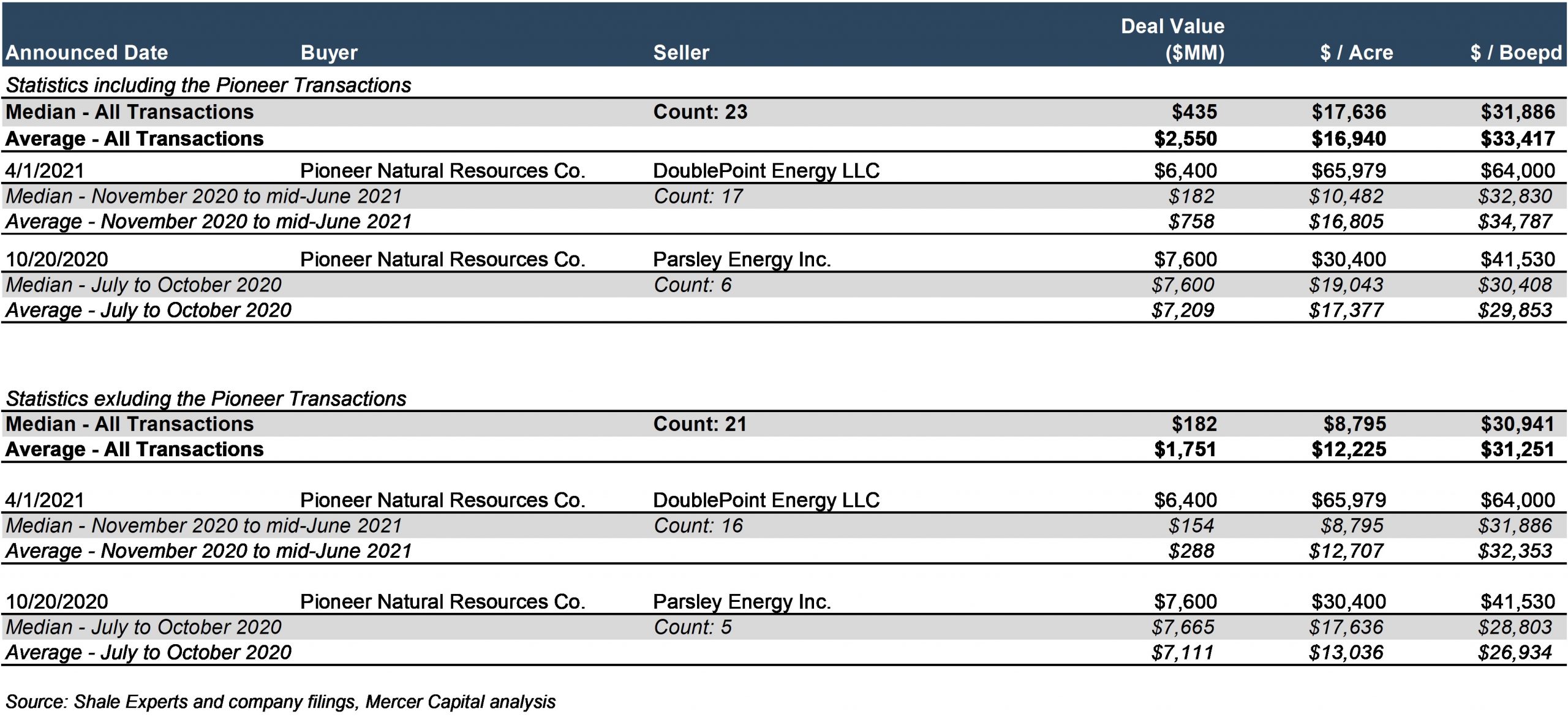
Among all the transactions that occurred over this period, one pair jumped out involving a common buyer and for which valuation metrics were available. These related to Pioneer’s acquisition of Parsley Energy in October 2020 and DoublePoint Energy in April 2021, with implied transaction metrics well above the average and median values in the the respective sub-periods of the reviewed period.  Statistics of the valuation metrics for the transactions occurring between mid-June 2020 to mid-June 2021 and the bifurcated sub-periods, both including and excluding Pioneer transaction data, are as follows:
Click Here to Enlarge the Image

We note that, as compared to the transactions table in the aforementioned Permian M&A activity blog post, the transaction counts and statistics presented exclude four transactions for which acquired assets were working interests, as opposed to a property or corporate acquisition.  We also note that only one of the four excluded transactions involving the acquisition of a working interest had any useful transaction data available, and the metrics for this one transaction tended to be outliers (on the high side) in the context of the full set of transactions.

Tech talk aside, the main point here is Pioneer consistently paid top dollar for its acquisitions from the perspective of the transactions’ valuation metrics.  Why?

Easy Answer: Pioneer Is a Large Strategic Buyer

In Pioneer’s October 2020 press release covering its acquisition of Parsley Energyand April press release for its acquisition of DoublePoint Energy, the strategic nature of the acquisitions was cited.  Prominent in both releases was mention of significant synergies and “unmatched scale” with respect to Pioneer’s footprint in the Permian play.

Regarding the Parsley acquisition, Pioneer’s President and CEO, Scott D. Sheffield, stated, “This combination is expected to drive annual synergies of $325 million and to be accretive to cash flow per share, free cash flow per share, earnings per share and corporate returns beginning in the first year.…”  It was further noted that, “The combined company will be the leading Permian independent exploration and production company with a premium asset base of approximately 930,000 net acres [representing an approximately 37% increase over its pre-transaction net acreage] with no federal acreage and a production base of 328thousand barrels oil equivalent per day (“MBoepd”) and 558 MBoepd as of the second quarter of 2020.  Additionally, based on year-end 2019 proved reserves, this transaction will increase Pioneer’s proved reserves by approximately 65%.

Similarly, synergies were noted in the DoublePoint acquisition, including expectations annual cost savings over the next 10 years of $175 million, stemming from increased operational efficiencies and reduced G&A and interest expenses, with a total present value of savings of approximately $1 billion.  This transaction also expanded Pioneer’s Permian footprint by an additional 97,000 net acres to over 1 million total net acres in its core Permian position.  This addition implies an increase of 10% over its 930,000 total net acreage holdings following the Parsley Energy acquisition, and further fortifies the company’s position as a premier Permian E&P operator.

While the strategic argument makes sense fundamentally, arguably any transaction involving an existing E&P company entering or expanding their presence in the Permian could be deemed a “strategic” acquisition.  Let’s dive a little deeper into the numbers behind Pioneer’s acquisitions to see if there may be another differentiating factor.

Deeper Answer: Production Density

In our analysis of Permian M&A activity over the past twelve months, we presented deal values and valuation metrics such as deal value per acre and per production (Boepd).  As might be gleaned from those metrics, our data set included the net acreage and production values associated with the acquisitions, though these specific data points were not presented outright.

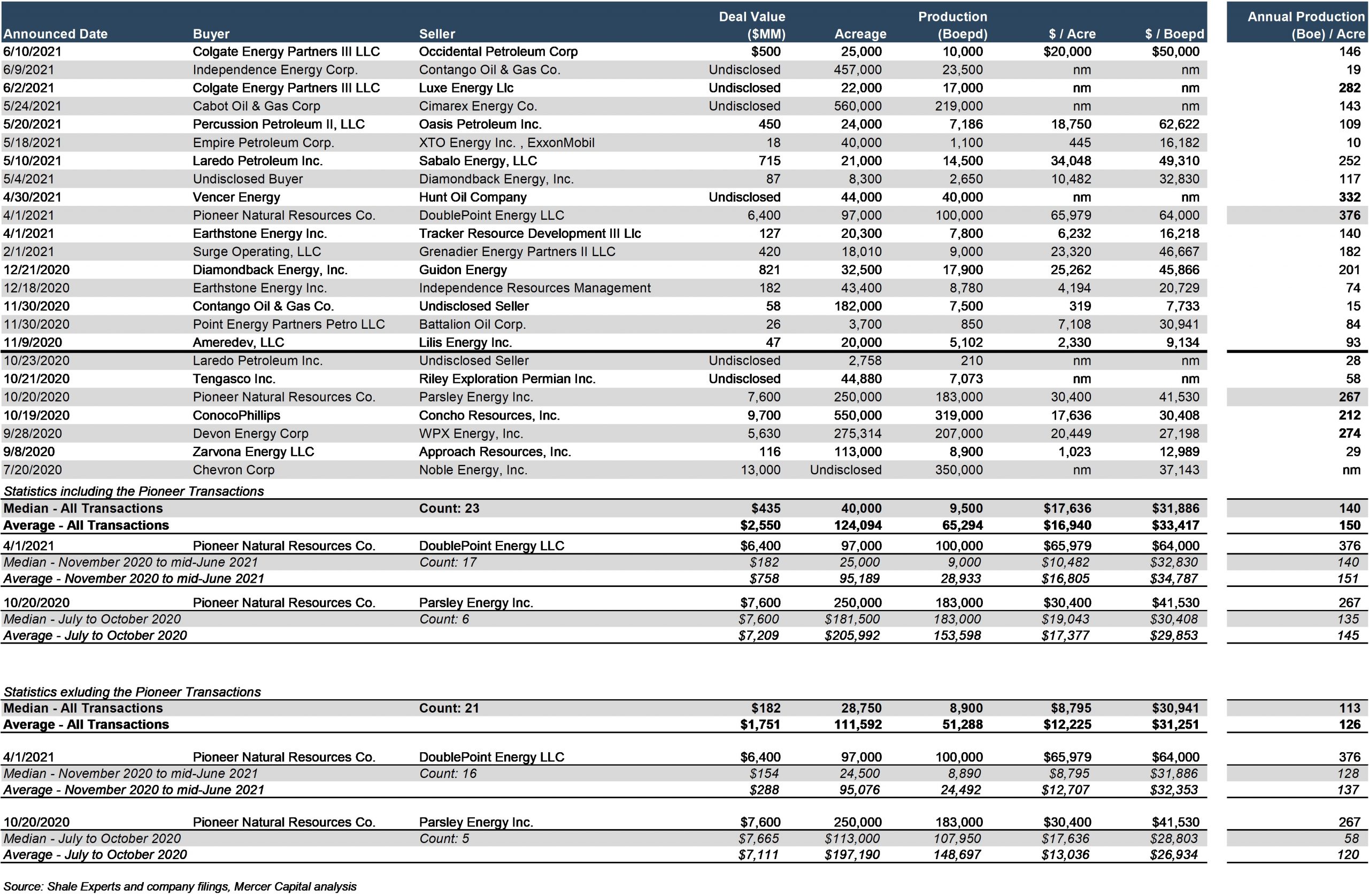
Utilizing the full set of data to examine the transactions, we developed and reviewed certain indicators beyond the presented valuation metrics.  In particular, we calculated the implied annual production (total implied Boe) per acquired acre for each transaction.  We’ll refer to this as “production density.”  The following table presents the full data set which will be referenced:
Click Here to Enlarge the Image

Pioneer’s acquisition of Parsley Energy indicated a production density factor of 267 Boe/acre.  Among the six transactions that occurred from July to October 2020, this was the second highest value, being only 7 Boe/acre lower than the highest indicated value implied by the Devon Energy-WPX Energy transaction.  Conversely, this production density factor of 267 Boe/acre was 26% greater than the next highest factor of 212 Boe/acre implied in the ConocoPhillips acquisition of Concho Resources, which was announced the day prior to the Parsley acquisition announcement.

Among the transactions announced from November 2020 through mid-June of this year, the production density factor of the Pioneer-DoublePoint Energy acquisition was 376 Boe/acre, which was just over 13% higher than the production density of the next highest value of 332 Boe/acre implied by the Vencer Energy-Hunt Oil acquisition, and was the highest value among all the acquisitions in the Permian listed over the full 12-month period ended mid-June.

Conclusion

In our prior analysis of Permian M&A activity from mid-June 2020 to mid-June 2021, several points came to light:

  • Transaction multiples appeared to have an inflection point, with significantly lower multiples indicated from the transactions announced after October 2020 relative to the indicated multiples for transactions announced prior to November 2020.
  • Given the publicly available information, Pioneer was the only buyer in both sub-periods noted (for which useful transaction data was available).
  • The transaction multiples stemming from the Pioneer acquisitions were among the highest, if not the highest, in the respective sub-periods, making them among the highest multiples for the entire 12-month period reviewed.
While commodity prices could have been a factor, we note that WTI futures as of April 2021 were, on average, 30% higher than WTI futures as of October 2020 when looking at a 12-month span consecutively for nine annual periods that followed the respective measurement dates.  On one hand, this could be interpreted to mean that valuations should have been greater in the latter sub-period (with higher futures prices).  On the other hand, the higher prices in the future might have been  indicative of uncertainty regarding the Biden Administration’s rhetoric and possible actions that would more than likely prove to be headwinds to the oil and gas industry overall.  Commodity prices notwithstanding, the data available and subsequent information gleaned from it suggest Pioneer was able to act on two prime opportunities that would further enhance the quality of its acreage and production portfolio. We have assisted many clients with various valuation needs in the full stream of the oil and gas space for both conventional and unconventional plays in North America, and around the world.  Contact a Mercer Capital professional to discuss your needs in confidence and learn more about how we can help you succeed.

Continue Reading

Defying the Cycle: Haynesville Production Strength in a Shifting Gas Market
Haynesville shale production defied broader market softness in 2025, leading major U.S. basins with double-digit year-over-year growth despite heightened volatility and sub-cycle drilling activity. Efficiency gains, DUC drawdowns, and Gulf Coast demand dynamics allowed operators to sustain output even as natural gas prices fluctuated sharply.
Haynesville Shale M&A Update: 2025 in Review
Key TakeawaysHaynesville remains a strategic LNG-linked basin. 2025 transactions emphasized long-duration natural gas exposure and proximity to Gulf Coast export infrastructure, reinforcing the basin’s importance in meeting global LNG demand.International utilities drove much of the activity. Japanese power and gas companies pursued direct upstream ownership, signaling a shift from traditional offtake agreements toward greater control over U.S. gas supply.M&A was selective but meaningful in scale and intent. While overall deal volume was limited, announced transactions and reported negotiations reflected deliberate, long-term positioning rather than opportunistic shale consolidation.OverviewM&A activity in the Haynesville Shale during 2025 was marked by strategic, LNG-linked transactions and renewed international investor interest in U.S. natural gas assets. While investors remained selective relative to prior shale upcycles, transactions that did occur reflected a clear pattern: buyers focused on long-duration gas exposure, scale, and proximity to Gulf Coast export markets rather than short-term development upside.Producers and capital providers increasingly refocused efforts on the Haynesville basin during the year, including raising capital to acquire both operating assets and mineral positions. This renewed attention followed a period of subdued transaction activity and underscored the basin’s continued relevance within global natural gas portfolios.Although the Haynesville did not experience the breadth of consolidation seen in some oil-weighted plays, the size, counterparties, and strategic motivations behind 2025 transactions reinforced the basin’s role as a long-term supply source for LNG-linked demand.Announced Upstream TransactionsTokyo Gas (TG Natural Resources) / ChevronIn April 2025, Tokyo Gas Co., through its U.S. joint venture TG Natural Resources, entered into an agreement to acquire a 70% interest in Chevron’s East Texas natural gas assets for $525 million. The assets include significant Haynesville exposure and were acquired through a combination of cash consideration and capital commitments.The transaction was characterized as part of Tokyo Gas’s broader strategy to secure long-term U.S. natural gas supply and expand its upstream footprint. The deal reflects a growing trend among international utilities to obtain direct exposure to U.S. shale gas through ownership interests rather than relying solely on long-term offtake contracts or third-party supply arrangements.From an M&A perspective, the transaction highlights continued willingness among major operators to monetize non-core or minority positions while retaining operational involvement, and it underscores the Haynesville’s attractiveness to buyers with a long-term, strategic view of gas demand.JERA / Williams & GEP Haynesville IIIn October 2025, JERA Co., Japan’s largest power generator, announced an agreement to acquire Haynesville shale gas production assets from Williams Companies and GEP Haynesville II, a joint venture between GeoSouthern Energy and Blackstone. The transaction was valued at approximately $1.5 billion.This acquisition marked JERA’s first direct investment in U.S. shale gas production, representing a notable expansion of the company’s upstream exposure and reinforcing JERA’s interest in securing supply from regions with strong connectivity to U.S. LNG export infrastructure.This transaction further illustrates the appeal of the Haynesville to international buyers seeking stable, scalable gas assets and highlights the role of upstream M&A as a tool for portfolio diversification among global utilities and energy companies.Reported Negotiations (Not Announced)Mitsubishi / Aethon Energy ManagementIn June 2025, Reuters reported that Mitsubishi Corp. was in discussions to acquire Aethon Energy Management, a privately held operator with substantial Haynesville production and midstream assets. The potential transaction was reported to be valued at approximately $8 billion, though Reuters emphasized that talks were ongoing and that no deal had been finalized at the time.While the transaction was not announced during 2025, the reported discussions were notable for both their scale and the identity of the potential buyer. Aethon has long been viewed as one of the largest private platforms in the Haynesville, and any transaction involving the company would represent a significant consolidation event within the basin.The reported talks underscored the depth of international interest in Haynesville-oriented platforms and highlighted the potential for large-scale transactions even in an otherwise measured M&A environment.ConclusionWhile overall deal volume remained selective, the transactions and reported negotiations in 2025 reflected sustained global interest in U.S. natural gas assets with long-term relevance. Collectively, the transactions and negotiations discussed above point to a Haynesville M&A landscape driven less by opportunistic consolidation and more by deliberate, long-term positioning. As global energy portfolios continue to evolve, the Haynesville basin remains a focal point for strategic investment, particularly for buyers seeking exposure tied to U.S. natural gas supply and LNG export linkages.
Mineral Aggregator Valuation Multiples Study Released-Data as of 06-11-2025
Mineral Aggregator Valuation Multiples Study Released

With Market Data as of June 11, 2025

Mercer Capital has thoughtfully analyzed the corporate and capital structures of the publicly traded mineral aggregators to derive meaningful indications of enterprise value. We have also calculated valuation multiples based on a variety of metrics, including distributions and reserves, as well as earnings and production on both a historical and forward-looking basis.

Cart

Your cart is empty