
Key Takeaways
Reinvesting in the business can help sustain or create momentum. In the public-company analysis, the highest shareholder-return group was more likely to invest aggressively in its future than the lowest-return group.
Investment discipline requires a clear strategy and return criteria that guide capital allocation. Investments should drive growth in earnings and cash flow, rather than simply expand the capital committed to the business.
Credibility influences how investors value a company’s future prospects. Family business managers and directors should build confidence in the company’s outlook among current and next-generation shareholders.
Here at Family Business Director, we think a lot about what makes companies valuable. We think about value in a lot of different ways, and sometimes we like to step back and look at some aggregate market data to test whether what we think we know about value actually stands up in the real world.
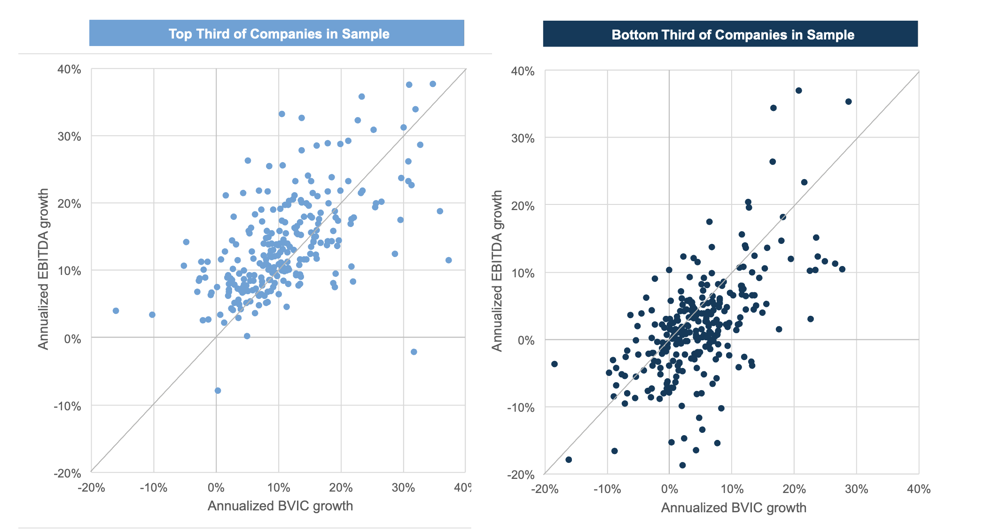
Recently, we examined data from the non-financial companies in the S&P 1500, which comprises S&P’s large cap (500), mid cap (400), and small cap (600) indices. We then calculated shareholder returns over the decade extending from December 31, 2015 through December 31, 2025. We sorted the companies by stock return and divided the group into thirds. Finally, we used the data to create the two following charts, which are not Rorschach tests, but rather comparisons of the growth rates of invested capital and EBITDA over the 10-year period analyzed for each group.
Well, perhaps they are Rorschach tests, because when we look at the scatter plots, we see three things that can make your family business more valuable.
So what are the three things we see in the charts?
Momentum. Companies that are creating value for their shareholders have momentum. They feed that momentum through reinvesting in the business. Putting more capital to work in your family business can help sustain momentum you already have or kickstart momentum you need. The horizontal axis on the preceding charts represents the annualized growth rate in the book value of invested capital (“BVIC”) for each firm, which is a proxy for how aggressively a company is investing in its own future. Look at how many companies fall on the right side (annualized BVIC growth > 10%) of each chart. Among the companies creating the most value, 163 (57%) reinvested at this rate compared to just 57 (20%) of the bottom performers.
Does your family business have momentum? If it does, are you investing at an appropriate pace to maintain that momentum? If not, what investments should you be considering to help create some momentum?
Discipline. Momentum is critical, but blindly investing for the sake of investing will not increase the value of your family business. Value-enhancing investments are those that drive growth in earnings and cash flow and it takes discipline to identify the right investments to make. The vertical axis on the preceding charts represents the annualized growth rate in EBITDA for each company over the same ten-year period. On each chart, the companies to the left / above the diagonal line running from the bottom left to the top right of the chart are those for which EBITDA growth has exceeded growth in BVIC. In other words, those companies have demonstrated discipline, investing in projects that have generated corresponding growth in cash flow. By this measure, two-thirds of the highest performing firms were disciplined investors, compared to just 30% of the lowest performing firms.
Does your family business have discipline? Do you have a clear strategy and return criteria that are used to screen investment opportunities that arise, or do you find yourself formulating strategy and setting return criteria to justify making investments that are available to be made?
Credibility. Investors set value based on expectations for the future, not because of what has happened in the past. When the market believes that a company’s story has credibility, it will assign a higher valuation multiple. By contrast, when investors are skeptical about a company’s outlook, the market assigns a lower multiple, and value evaporates. At the beginning of our ten-year lookback period, both the high performers and the low performers traded at similar multiples (about 11.5x EBITDA). Ten years later, the median EBITDA multiple for the high performers had expanded to nearly 19x, while the median multiple for the low performers had contracted to about 9.5x. In other words, investors had more faith in the future outlook for the high performers at the end of the period than the low performers. One group had built credibility with the market while the other had squandered it.
What story does your family business tell about its future? Is that story credible to your current family shareholders? To the next generation of family shareholders? To third-party acquirers? If sustaining the family business across generations is a goal, managers and directors need to work on maintaining and building credibility with current and future family shareholders.
We have intentionally oversimplified things a bit in this post. Many factors influence the value of your family business, but focusing on momentum, discipline, and credibility is a great way to start building value.