
Key Takeaways
Capital spending should follow corporate strategy, with directors evaluating whether proposed investments align with long-term objectives and attractive opportunities rather than allowing available projects to dictate strategy.
Family businesses should assess whether current opportunities call for a “planting” or “harvesting” posture and match financing choices to the availability and marginal cost of capital as investment needs evolve.
Net present value remains the preferred measure for evaluating whether major capital projects are expected to create shareholder value, while directors should also consider the effects of those investments on leverage, liquidity, distributions, and shareholder expectations.
Median capital expenditures for private companies in the 2026 Family Business Benchmarking Study increased 4% in 2025, while median net fixed asset balances increased 2%. Those figures tell us that family businesses were investing, but not whether they were investing wisely. For directors, the more important questions are strategic; what opportunities are available? How should we finance it? And will the expected return justify the risks? The extraordinary capital commitments being made by some of the world’s largest technology companies offer a useful, if outsized, case study for considering those same questions.
During the second quarter of 2026, the non-financial companies in the S&P 1500 index reported total capital expenditures of $388 billion. The five biggest spenders (Amazon, Alphabet, Microsoft, Meta, and Oracle) accounted for $182 billion, or 47% of the total. To be clear, those five companies spent nearly as much as the other 1,075 companies combined.
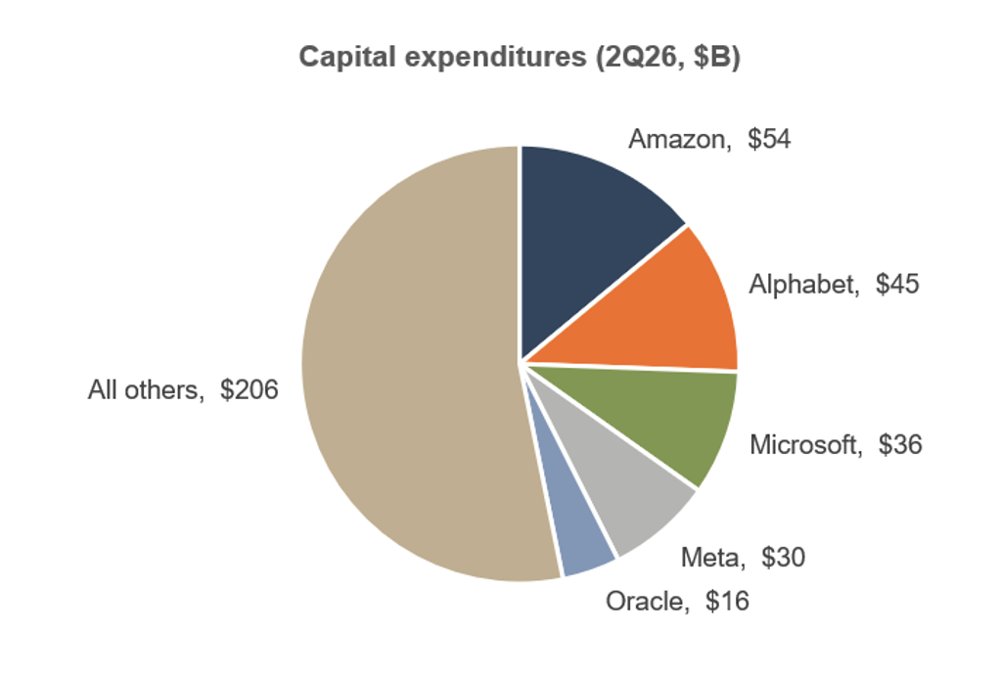
The sheer volume of spending by these so-called hyperscalers is, frankly, hard to comprehend and certainly dwarfs anything your family business is likely contemplating. That said, the phenomenon is worth considering by family business directors.
1 – Corporate strategy should drive capital spending.
As we’ve written previously in Three Questions to Consider Before Undertaking a Capital Project, the most successful family businesses define their strategy first, using it as the first “screen” for evaluating potential capital projects. Less disciplined spenders try to craft a strategy to fit available capital projects, which, in our experience, leads to over-spending and under-performance.
In broad strokes, the strategy of hyperscalers reflects a conviction that the demand for computer processing facilities is, in some sense, unbounded. Current performance provides some initial confirmation for this thesis.
Consider this comment from Amazon’s quarterly earnings release: “AWS is booming, growing 36.7% year-over-year in Q2 – our fastest growth in 18 quarters – and our AI and Chips businesses each eclipsed run rates of more than $25 billion.”
Or this from Alphabet: “Q2 was an amazing quarter, with Alphabet revenues growing 24% year-over-year and Google Cloud revenues accelerating to 82% growth, driven by demand for AI infrastructure and AI solutions.”
In other words, the capital spending for these firms is in support of the hyperscalers’ broader corporate strategy.
2 – Opportunity dictates what time it is for your family business.
We have long found it helpful in What Time Is it for Your Family Business? to classify businesses as either planters (they invest more cash flow than they generate) or harvesters (they generate more cash flow than they invest). Family business directors bear the responsibility of discerning what time it is for their businesses. Whether it is time to harvest or time to plant depends, in large part, on the availability of attractive investment opportunities.
As the following chart depicts, the five hyperscalers flipped from harvest to planting mode during the first two quarters of 2026.
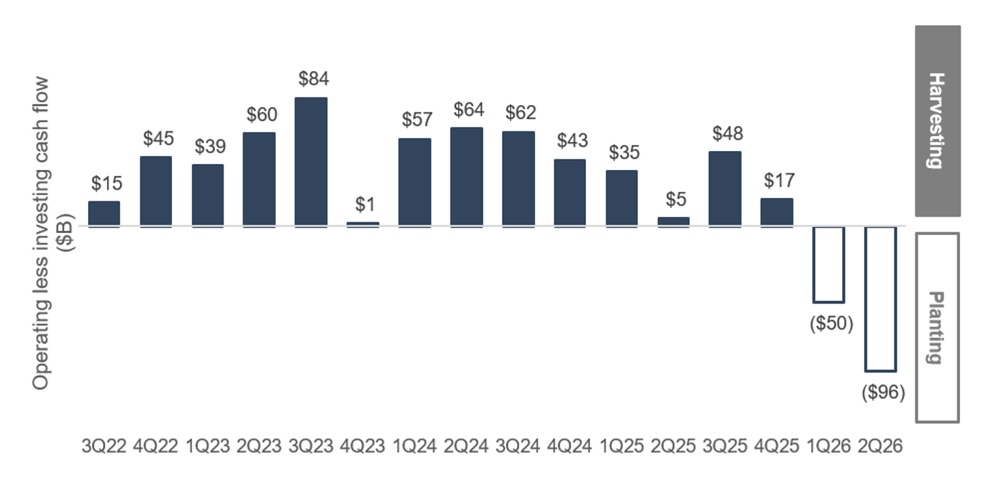
Sensing opportunity in data center construction, the hyperscalers left their harvesting habits behind and assumed the role of planters. In other words, they decided that the future benefits of planting today outweighed the more immediate benefits of harvesting.
3 – Availability and marginal costs of capital influence financing decisions.
Planters need capital. We have observed that family businesses rely on a “capital ladder” when it comes to obtaining financing in The Capital Ladder: Where Will the Next Dollar Come From?. Businesses often look to internally generated cash flow as the first source of financing and then pivot to lenders when internal funds are no longer sufficient.
The behavior of the hyperscalers over the past several quarters confirms the existence of the “capital ladder” even for the largest public companies. As capital spending outgrew available internally generated funds, the companies first turned to the debt markets to provide the necessary investment capital. Equity returned to the mix in 2Q26. These developments illustrate that the preferred source of the next dollar of capital can change as financing needs grow and the relative costs of available alternatives evolve.
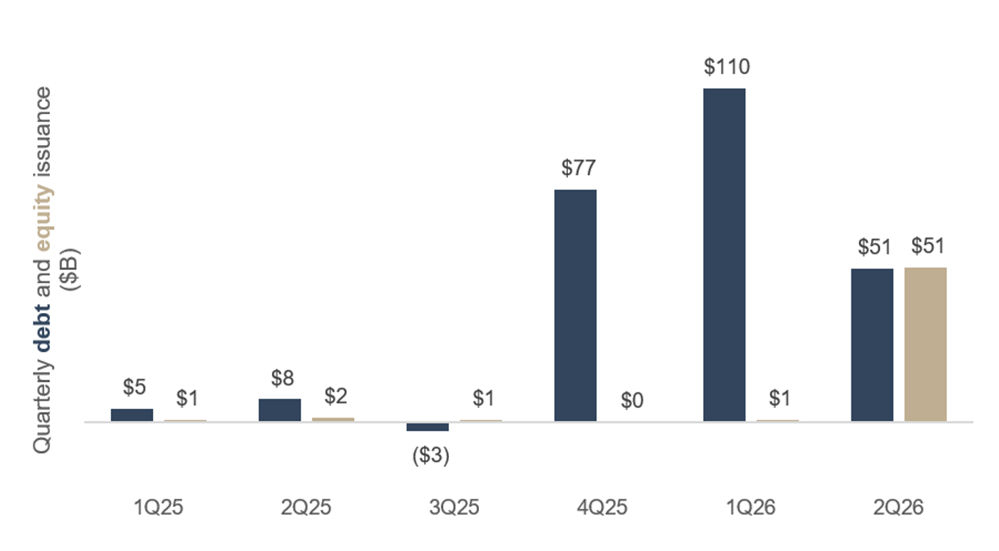
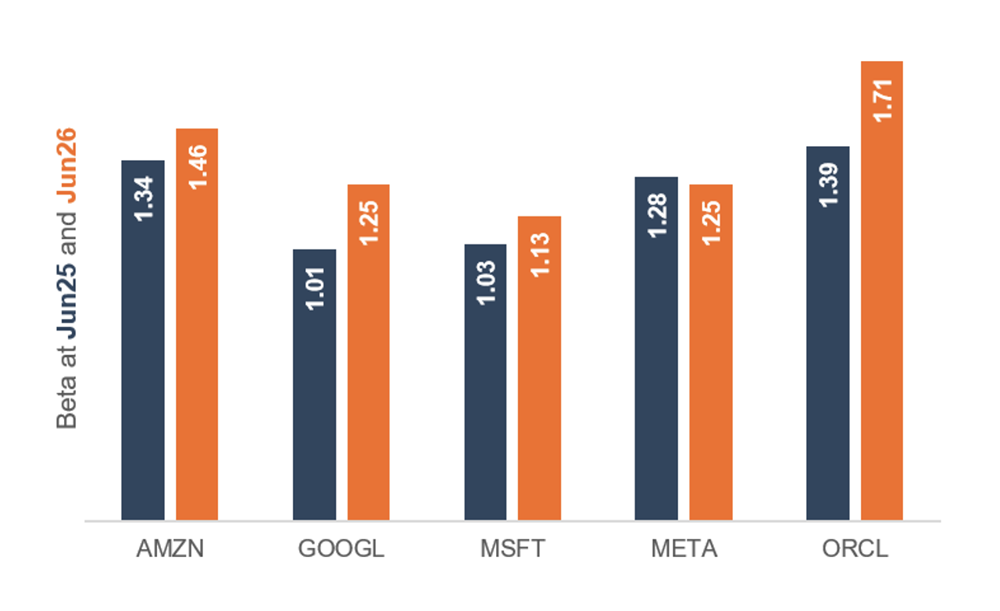
When making long-term financing decisions, family business directors should distinguish between the nominal cost of debt (the interest rate) and the marginal cost of debt (the impact of incremental borrowing on the company’s overall cost of capital). Just because debt has a lower relative cost than equity does not mean that companies should always continue to borrow. Increasing leverage not only makes borrowing more expensive, but it also increases the risk (and therefore cost) of equity. Directors should be sensitive to the iterative nature of capital costs. Indeed, as shown below the equity risk of the hyperscalers as measured by beta increased materially over the past year.
When attractive investment opportunities arise for your family business, what will the capital ladder look like? Will the availability and marginal cost of borrowing ultimately constrain the growth potential of your family business?
4 – Net present value measures the impact of capital investment decisions on value.
When screening potential capital projects for financial feasibility, net present value is the preferred metric. Put simply, net present value measures the difference between the cost of a project today and the present value of expected future benefits from the project, discounted at an appropriate risk-adjusted rate. If the net present value is positive, the value of the company should increase when the investment is made; on the other hand, if the present value of anticipated benefits does not equal or exceed the cost of the project, making the investment will erode shareholder value.
We don’t have visibility into the net present value calculations of the hyperscalers, but we can observe whether investors believe that the investments are increasing or decreasing shareholder value.
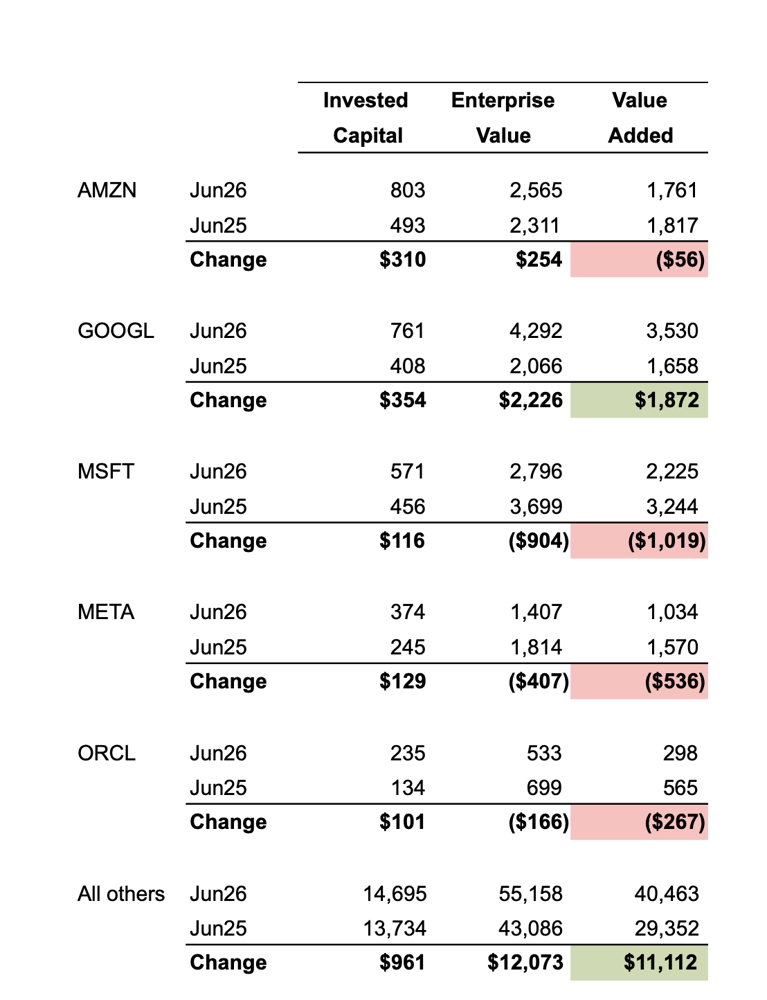
Clearly, many factors influence the market values of the hyperscalers. That said, during a period of generally rising market value added, four of the five hyperscalers experienced contractions in market value added during the twelve months ending June 30, 2026, suggesting that – aside from Alphabet – investors may not perceive the massive capital expenditures taken on by these companies to represent positive net present value projects.
Aggressive investment doesn’t necessarily translate into higher values. Managers make plans, but investors have the final verdict. Prudent family business managers and directors understand the need to inform and persuade family shareholders before embarking on significant capital projects. Unanimity cannot be the goal, but garnering broad family support is a judicious strategy for family business leaders.
Conclusion
The extraordinary spending of the hyperscalers offers family business directors a magnified view of decisions they must make on a more familiar scale: when to invest, how to finance that investment, and whether the rewards anticipated justify the risks assumed.
The biggest capital projects are rarely just operating decisions. They also affect leverage, distributions, shareholder liquidity, and family expectations. Directors who evaluate those connections before committing capital will be better positioned to pursue attractive opportunities without sacrificing financial resilience or shareholder confidence.