Key Takeaways
Buy-sell agreements can become outdated as a family business’s ownership structure, debt, liquidity needs, and broader financial circumstances change over time.
Walking through a hypothetical triggering event before one occurs can expose gaps or unrealistic expectations around triggers, purchase obligations, valuation, payment terms, and funding.
The key risk is not necessarily a flawed provision, but misalignment between the agreement and current shareholder expectations or the company’s financial capacity. Reviewing the buy-sell agreement alongside ownership strategy, capital structure, redemption policy, and liquidity objectives can help identify conflicts before they threaten the sustainability of the business.
When Was the Last Time Anyone Read the Buy-Sell Agreement?
Years can quickly pass without anyone reviewing a family business’s buy-sell agreement if the shareholder base has remained stable and no triggering event has occurred. Yet, the business and the family may have changed considerably, causing the buy-sell agreement to be outdated and stale. Reviewing the buy-sell agreement to evaluate whether the agreement still reflects the business and its shareholders can serve as an important risk management tool.
Has the Agreement Kept Up with the Business?
Consider a family business that adopted its buy-sell agreement fifteen years ago, when ownership was concentrated among a few active family members and the company carried minimal debt. The shareholders expected to remain invested for the foreseeable future, and the buy-sell agreement established a process for transferring and valuing shares if one of several triggering events occurred.
Fifteen years later, the company has tripled in size. Ownership has spread among multiple family branches, the company has made acquisitions and taken on debt. In contrast to fifteen years ago, some shareholders now place greater value on liquidity and diversification. Because the cost and distraction of a prolonged dispute following a triggering event is so significant, directors should ask whether the terms of the legacy agreement still match the new business and family contexts. Periodic review is important because a buy-sell agreement cannot anticipate every change in the business or family.
Walk Through the Agreement Before You Need It
One practical way to review the agreement is to select a mock triggering event and walk through the process from beginning to end. Doing so can help ensure that the company and shareholders are not surprised or carry unrealistic expectations into a triggering event. A mock triggering event helps the parties understand key provisions of the agreement, such as:
What events trigger the agreement, and what happens when one occurs?
Is the Company or are the remaining shareholders required or permitted to purchase the shares?
How is the purchase price determined, and what valuation date, standard of value, and appraisal process, if any, apply?
When and how must the purchase price be paid?
How would the purchase be funded, and what is currently in place around liquidity, borrowing capacity, dividends, and reinvestment?
Does that process still reflect what shareholders expect the agreement to accomplish?
Once a triggering event occurs, the parties will inevitably interpret the agreement from their new perspective as either buyer or seller. Therefore, the best time to test the process is before anyone knows which side of the transaction they will be on.
Look for Misalignment, Not Just Problems
Reviewing a buy-sell agreement does not mean looking for an excuse to rewrite it. Some provisions may intentionally restrict transfers, establish a particular definition of value, or structure payments over time to protect the financial health of the business. An outcome that surprises a shareholder does not necessarily mean the agreement is flawed.
The greater risk is that shareholder expectations have changed while the agreement has not. Some shareholders may view the agreement primarily as a mechanism for providing liquidity, while others may see its principal purpose as preserving ownership continuity and protecting the financial strength of the company. Problems are more likely to arise when shareholders do not share a common understanding of what the agreement is intended to accomplish.
The buy-sell agreement should therefore be reviewed alongside the company’s current capital structure, redemption policy, shareholder liquidity objectives, and broader ownership strategy. A liquidity mechanism that looked manageable when the agreement was signed may create very different demands on the business today. The time to identify those conflicts is before a triggering event creates a shareholder dispute that can threaten the sustainability of the business.
Conclusion
Buy-sell agreements are easy to ignore. During long periods with no triggering events, the business, the shareholder base, and the financial capacity of the company can change substantially. Family business directors should periodically walk through what would happen if the agreement were triggered today. If the resulting process no longer reflects current shareholder expectations or the financial realities of the business, directors and shareholders should address those issues while the discussion is still hypothetical. The worst time to find out what the buy-sell agreement says is when someone needs to use it.
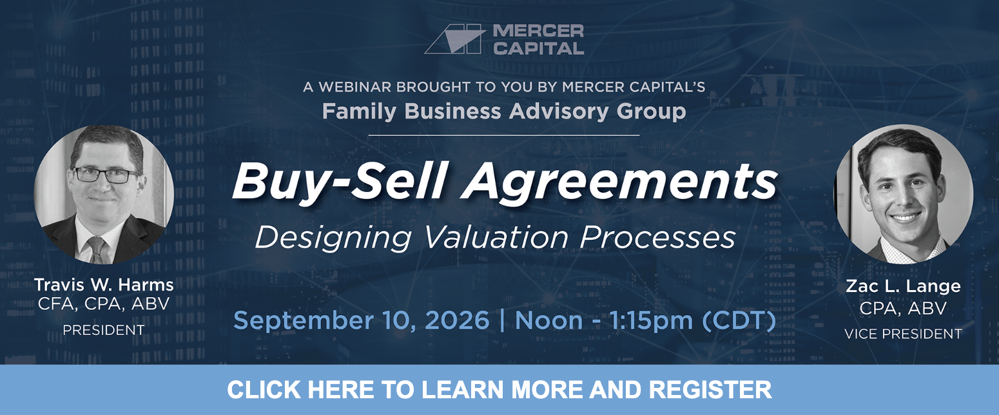
Join us next Thursday, September 10th at Noon CT for a live webinar, as we dive deeper into buy-sell agreements and designing the valuation process.
Upcoming Webinar