Consolidation is a theme that has a lot of traction in the RIA industry: that a growing multitude of buyers are scrambling to outbid each other for a limited and shrinking number of firms.
Circumstances, such as, aging founders or a lack of internal succession planning are bringing firms to market, where firms are quickly bought up and rolled into any one of a number of acquisition models that have emerged (and continue to emerge) in the industry. Aggregators are bolting RIAs onto their platforms, branded acquirers are assembling RIAs with national scale through a series of acquisitions, and larger RIAs are growing through strategic acquisitions of smaller firms. Competition amongst these buyers for the limited number of firms coming on the market has driven acquisition activity and multiples to all-time highs.
With the rapid pace of deal activity in the RIA industry, you might expect to see the number of firms decline, as that is typically the norm for consolidating industries. The banking industry, for example, has been consolidating for three decades and, as a consequence, the number of banks in the U.S. has steadily declined from about 18,000 in 1990 to about 6,000 today. But that’s not been the case in the RIA industry, at least yet.
Despite consolidation pressures and record levels of acquisition activity, the reality is that the number of RIAs continues to increase, with formations outpacing consolidation. In 2019, there were approximately 13,000 individual SEC registered investment advisory firms, up from about 10,900 in 2014.
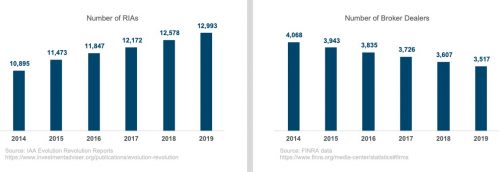
Several factors have contributed to the increase in the number of RIA firms. For one, the RIA industry has experienced secular tailwinds from the shift from the broker dealer / commission model to the fee-based, fiduciary model. As the chart demonstrates, the number of FINRA registered broker dealers has gradually declined in recent years—the mirror image of the growth seen in the RIA industry. In many cases, broker dealers have shifted to fee-based models, and firms with dual registrations have gradually shifted to the RIA side of the business.
This overarching shift from the broker dealer model to the RIA model is multi-faceted. For one, it’s clear that clients (in general) prefer the advisory relationship offered by RIAs over that offered by their broker dealer counterparts. And a model that’s in demand by clients is also in demand by advisors. Additionally, we’ve found that building significant enterprise value (value attributable to the business, not the individual) is generally easier for firm owners to achieve under the RIA revenue model than the broker dealer model. This prospect of building a business with enduring value that can be sold to an external buyer at the end of the founder’s career or transitioned to next generation management is a key motivation behind many advisors’ decisions to start their own RIA. It also doesn’t hurt that, compared to the broker-dealer model, the amount of capital required to start an RIA is relatively minimal.
When looking at the increase in the number of RIA firms, though, there are a couple of nuances to keep in mind. Some acquisition models in the industry result in the acquired firm maintaining its SEC registration, so consolidation doesn’t necessarily mean a decline in the number of registered firms. Another caveat is that the data captures only SEC-registered investment advisors and not state registered investment advisors (generally, advisory firms with over $100 million in AUM are required to register with the SEC, whereas firms below that threshold are regulated by the state in which they do business). These wrinkles aside, the data is unambiguous that there are more SEC registered advisory firms today than ever before—and that’s hardly indicative of an industry in the throes of consolidation.
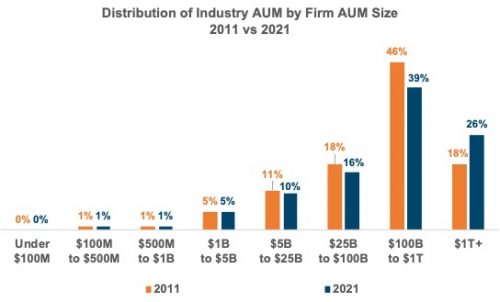
Another way to track consolidation is to look at how assets under management are distributed across firms of different sizes, rather than at the number of firms. The industry hasn’t seen significant consolidation by this metric either. Consider the chart below, which shows the distribution of industry assets across different sized firms in 2011 and 2021. After a decade of significant M&A activity and strong market growth, the distribution of assets across different size firms looks about the same as it did ten years ago. Then, as now, firms under $100B AUM controlled approximately one-third of industry assets, while firms over $100B control approximately two-thirds of industry assets. What we haven’t seen is an erosion of market share for smaller firms; in fact, they’ve maintained market share in a growing market.
What does all this mean for the industry? As it stands today, rising supply of RIAs has done little to dampen the pricing for RIAs; instead, it’s seemingly added fuel to the M&A fire. Notwithstanding an increase in the number of firms, attractive firms whose founders are open to selling today remain scarce, and the ratio of buyers to sellers remains high. As a consequence, multiples for RIAs are at or near all-time highs today. Whatever downward pressure there’s been from the supply side of the equation, strong buyer demand has more than offset it.
While the consolidation pressure in the industry is real, we are still in early stages. Many successful advisory practices prefer to go at it alone and transition internally, unless circumstances such as age of the principals or lack of next-generation management arise to force an external transaction. Consolidation pressures may ultimately lead to an increase in the number of firms that are on the market and a shift in the supply/demand equilibrium, but as it stands today, sellers are scarce, and building a new firm from scratch is difficult. Time will tell if the RIA industry sees the same level of consolidation as we’ve seen in the banking industry, but at least in the near term, the number of RIA firms appears poised to continue growing as the supply of new firms more than offsets a significant level of M&A activity.


