
Key Takeaways
Internal succession requires more than identifying the next generation of leadership. Over time, responsibility, authority, and ownership all have to move in the same direction.
Compensation should become longer-term as an employee’s relationship with the firm develops. Salary, bonus, synthetic equity, and ultimately actual equity can reflect increasing levels of mutual commitment between a firm and its future leaders.
Internal transactions often occur at lower valuations than external sales, but gradual ownership transition can allow senior owners to monetize their investment while retaining substantial exposure to the value created by the next generation.
Of all the dilemmas we consult on with RIAs, the most psychologically complex is succession. Firms are meant to outlast careers, but it’s not easy to define when, or over what period, to hand off the senior leadership and economic positions at an RIA. Succession requires the right parties coming to the right terms at the right time. It may not have to be perfect, but it should be close.
Succession conundrums at our clients’ firms remind me of stories about endurance racing, which usually involves multiple drivers trading off to remain sharp behind the wheel. I say usually because there are a few famous stores of drivers failing to give their responsibility to a co-driver, often with disastrous consequences.
In 1952, Pierre Levegh nearly won the 24 Hours of Le Mans single-handedly. Levegh was driving a Talbot-Lago T26 GS, a postwar French racing car that would have been outmatched by the factory Mercedes-Benz 300 SLs entered that year. His co-driver was René Marchand, although “co-driver” became something of an honorary title. Levegh stayed in the car through the evening, through the night, and well into Sunday morning, supposedly concerned about a vibration that he wasn’t sure Marchand would recognize or know how to manage.
Whatever his car lacked in capability, Levegh made up for behind the wheel. With a little more than an hour remaining, after driving for nearly 23 hours, he had a comfortable lead. Then the Talbot broke. A connecting rod failure (likely the source of the vibration that Levegh thought only he could handle) ended the race, leaving Mercedes to finish first and second.
There is some irony in an endurance race being lost, at least in part, because one driver was unwilling to share the driving. There is also something familiar about an enormously capable person concluding that, given everything at stake, it would be safer to just keep doing the job himself.
The Trouble with Being Indispensable
We’ve written quite a bit about succession in the RIA industry, usually focusing on economics. Successful investment management firms can become extraordinarily valuable, which is nice until the founding generation wants the next generation to buy them out. The people best positioned to run the business may have plenty of human capital but nowhere near the financial capital necessary to buy it.
Before getting to that problem, though, there is another transition that has to occur.
Founders spend much of their careers becoming indispensable. They develop client relationships, recruit employees, make investment decisions, allocate capital, and establish the culture of the business. With enough success, decades of experience reinforce the entirely reasonable belief that they know how to run the firm better than anyone else.
Succession eventually requires a different measure of success. The ultimate compliment to a retiring generation of leadership is that they are no longer needed. They may still be valued, consulted, respected, and welcomed at the Christmas party. But a firm that can’t function without its founders isn’t built to last.
This is particularly difficult because we tend to think of the founding generation as having created the business and the next generation as inheriting it. I don’t think that’s quite right for professional services firms.
Every generation of leadership is, in an important sense, a founding generation. The competitive landscape changes. Client needs change. Technology changes. The labor market changes. New services become possible while old ones become obsolete. The skills that built an RIA in 1995 aren’t the skills required to run one in 2035.
The next generation therefore needs the mandate to build the firm it will lead, which inevitably means making decisions the prior generation wouldn’t make. The founders had that latitude when they built the business. Eventually, their successors will need it as well.
Compensation and the Path to Ownership
Leadership transition and ownership transition don’t have to happen simultaneously (and maybe shouldn’t). Instead, compensation can evolve as the relationship between a firm and its future leaders matures.
Early in someone’s career, neither side knows how permanent the relationship will be. Salary works nicely under those circumstances: do the job this month and get paid this month. Bonus compensation extends the horizon by rewarding contribution over the course of a year. Synthetic equity, such as phantom stock, can reach further by deferring compensation and tying the employee’s economics to the performance of the business over several years.
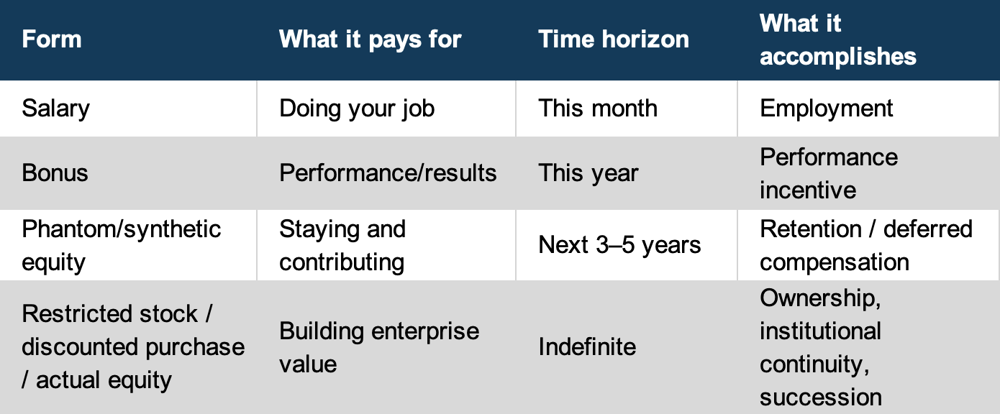
As the time horizon lengthens, something else is happening: the organization and the employee are learning to trust each other. The employee is increasingly committing a career to the firm, while the firm is becoming increasingly confident that the employee can help steward the enterprise.
For people expected to become the next generation of leadership, that progression should eventually arrive at actual equity. Phantom stock can replicate some of the economics of ownership, but it doesn’t change the cap table. If a designated successor spends an entire career as an employee, one side or the other probably didn’t fulfill its end of the succession bargain. Perhaps the senior generation couldn’t let go. Perhaps the next generation never demonstrated that it was ready. Sometimes it’s both.
The Problem with Successful Firms
A founder who started an RIA with a laptop, a handful of clients, and a questionable office lease didn’t have to finance the purchase of a valuable business. The next generation does. After twenty or thirty years of market appreciation, organic growth, and accumulated profitability, the ownership G1 acquired for sweat equity will cost G2 millions of dollars.
This is where equity compensation and transaction structure begin to overlap. Restricted stock, grants, internal purchases, seller financing, deferred payments, and distributions that can be recycled into subsequent purchases all provide ways to move ownership gradually. One of the principal barriers to succession is the difficulty younger advisors have financing meaningful purchases of increasingly valuable RIAs.
Unfortunately, the longer you wait to make that transition, the more difficult it can become. Waiting until the founder wants to retire and then asking the next generation to buy the company is a difficult way to finance succession. Moving equity gradually over ten or fifteen years gives everyone more options. It may also produce better economics for the selling generation than is immediately apparent.
Selling for Less, but Making More?
Internal buyers usually pay less than external buyers for RIA interests, a topic we’ve discussed before. That doesn’t necessarily make internal succession the economically inferior alternative. The comparison depends on what happens over the entire transition period.
An external sale offers liquidity and, frequently, a higher valuation today. A gradual internal transition allows senior owners to sell portions of their holdings while continuing to receive distributions on the shares they retain. If the next generation grows the business, G1 also participates in the appreciation of that retained ownership. Eventually, those shares can be sold at a higher enterprise value.
There are no guarantees that a carefully executed internal transition will outperform an external sale. There are risks to remaining invested, just as there are risks embedded in rollover equity and contingent consideration offered by external buyers. But focusing exclusively on the valuation applied to an internal stock sale misses much of the economics.
It also misses the reason for bringing the next generation into ownership in the first place. Giving or selling equity to talented younger professionals may reduce G1’s percentage ownership, but the objective is to give those professionals both the incentive and the opportunity to make the business more valuable. A smaller percentage of a substantially more valuable firm has worked out well for plenty of founders.
And the enterprise has constituencies beyond the cap table. Employees need careers, clients need continuity, and vendors and other stakeholders benefit from a healthy institution. Those considerations matter, although owners don’t necessarily have to choose between serving them and achieving a good financial outcome themselves.
Which brings us back to Le Mans. The object of an endurance race is to get the car to the finish as quickly as possible, not to see how long one driver can stay behind the wheel. The problem for the Talbot-Lago team wasn’t that Pierre Levegh couldn’t drive – it was that, eventually, he couldn’t keep driving. A successful driver change requires having someone ready to take over, enough confidence to give them the car, and an acceptance that they may drive it differently.
For a generation of RIA leaders approaching the end of a successful career, having built a firm that can prosper without them might feel a little strange. It should also feel like winning.
About Mercer Capital
Mercer Capital is a valuation and advisory firm organized by industry specialization. Our Investment Management Team provides valuation, transaction, litigation, and consulting services to asset managers, wealth managers, independent trust companies, broker-dealers, PE firms, and alternative managers.