
Key Takeaways
Recent fund inflows signal renewed investor confidence, but capital is being allocated selectively rather than broadly across asset classes.
Active management is stabilizing and evolving through vehicles like ETFs, though scale, distribution, and operating efficiency remain key competitive advantages.
Valuations and growth prospects are increasingly driven by differentiation, earnings quality, and strategic positioning rather than firm size alone.
After years of obituary-writing for traditional asset managers, 2026 has opened with a twist: money is flowing back into the system… and not quietly.
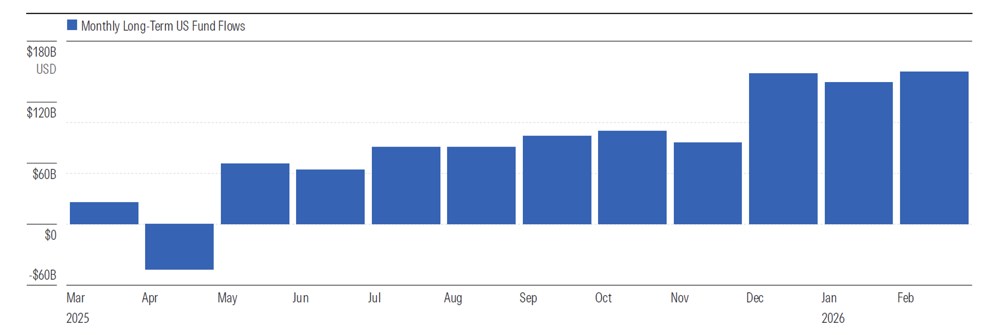
Morningstar reports that long-term U.S. funds pulled in more than $150 billion in February alone, marking one of the strongest stretches of inflows since 2021. For an industry that has spent much of the last decade explaining away outflows, that’s a welcome headline.
But before declaring victory, it’s worth asking a more important question: where is the money actually going and who is capturing it? As usual in asset management, the answer is not evenly.
Flows are Back, but Not Broad-Based
Source: Morningstar Direct Asset Flows. Data as of Feb. 28, 2026.
The recent surge in flows did not appear overnight. Inflows have been building steadily since mid-2025, with a clear acceleration into year-end and early 2026. What stands out is not just the magnitude, but the consistency. That kind of persistence suggests something more durable than a short-term market reaction; it points to a shift in investor positioning.
Still, the allocation of those flows tells the more important story.
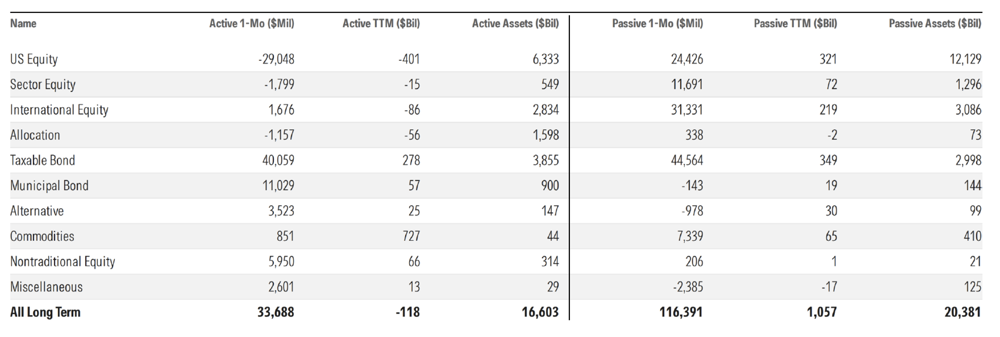
Fixed income has quietly reasserted itself as a core allocation, with taxable bond funds attracting roughly $85 billion in February alone, accounting for more than half of total inflows. After years of limited yield, investors appear comfortable leaning back into duration and credit as spreads widen and income becomes meaningful again.
Equities are seeing rotation rather than retreat. International equities have attracted sustained inflows, supported by strong relative performance, while U.S. investors have shifted exposure within the market—favoring value-oriented strategies and select sectors over growth. Sector flows into industrials, energy, and defense reinforce the idea that capital is being deployed with intention, not simply chasing beta.
Source: Morningstar Direct Asset Flows. Data as of Feb. 28, 2026.
The allocation data also underscores a more nuanced point around active management. As shown in the allocation data above, active strategies continue to attract flows in areas such as taxable fixed income and select equity segments, even as passive dominates headline totals. The takeaway is less about “active vs. passive” and more about where active still matters. In practice, that has meant areas such as fixed income, less efficient equity segments, and strategies where implementation and risk management are more differentiated.
Active is Evolving, and Scale Still Has the Edge
Source: Morningstar Direct Asset Flows. Data as of Feb. 28, 2026.
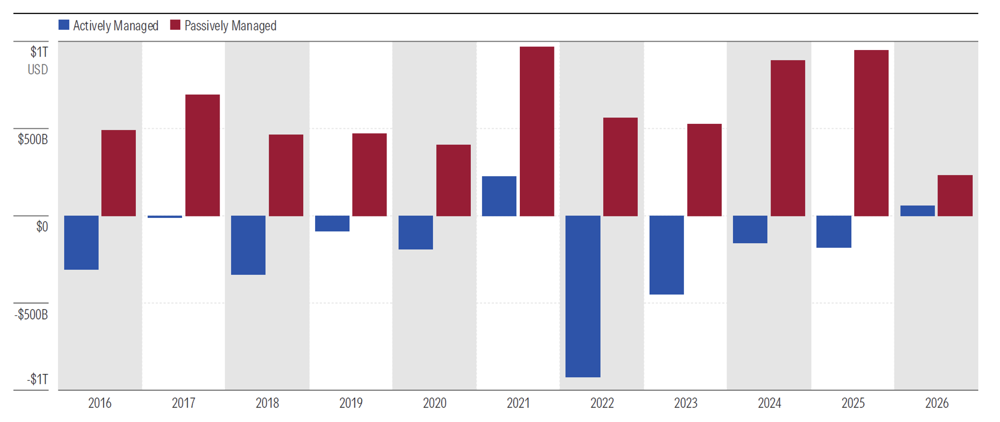
Over the past decade, passive investing has steadily gained share, often at the expense of traditional active strategies. That trend has not reversed, but it may be stabilizing. Active flows, while still uneven, are no longer uniformly negative, and in some areas, they are improving.
The more important shift is structural: active management is increasingly being delivered through ETFs and other vehicles that align better with how investors access strategies today. Firms that have adapted to this shift by pairing active strategies with modern distribution are beginning to see results. Those that have not are finding it harder to compete, regardless of performance.
At the same time, market performance continues to influence outcomes across the industry.
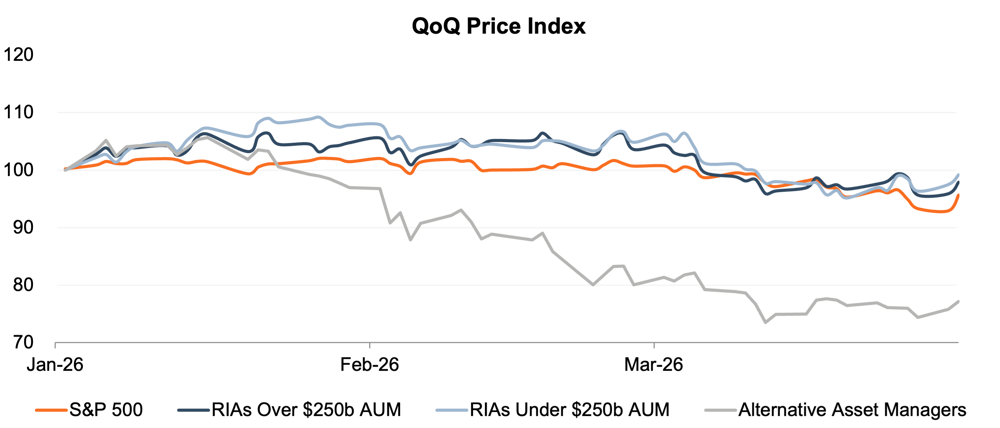
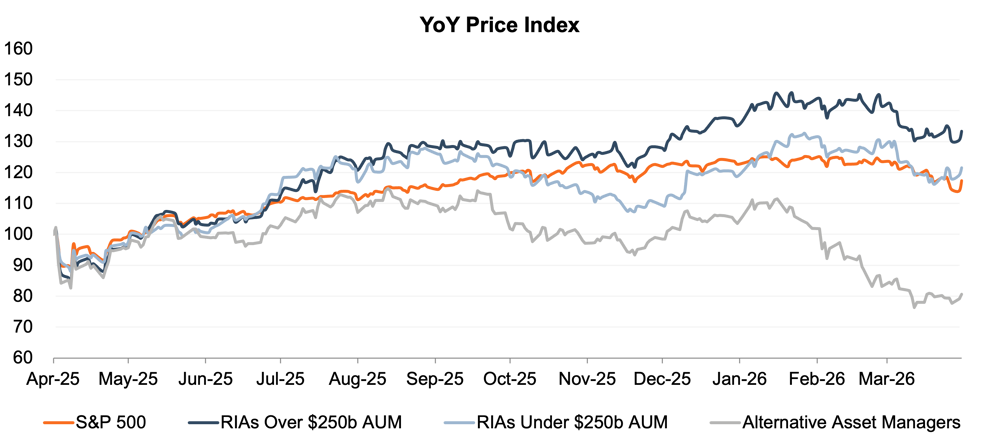
Public market performance has supported AUM growth broadly, but not all firms are benefiting equally. Larger RIAs have generally kept pace with (or outperformed) broader market indices, while alternative asset managers have lagged more recently. That divergence highlights an important reality: market beta alone is not driving results.
Scale continues to matter, but it is not just about asset size; it is about operating model. In practical terms, that includes product breadth, distribution reach, and the ability to spread fixed costs across a larger asset base.
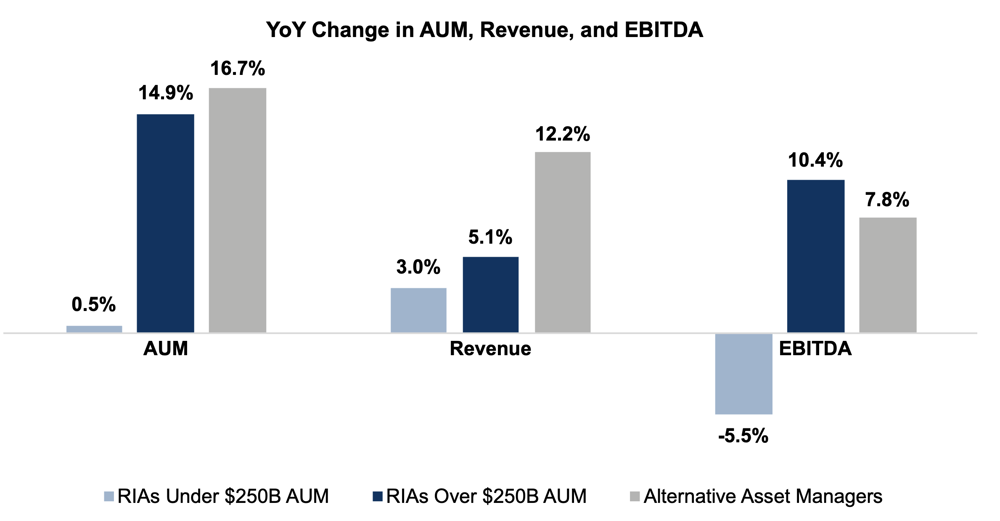
While AUM has increased across segments, the translation into financial performance has been uneven. Larger firms have been better positioned to convert asset growth into revenue and EBITDA expansion, benefiting from operating leverage and diversified product sets. Smaller firms, by contrast, have faced margin pressure, with some experiencing declining profitability despite modest AUM growth.
Valuation, Strategy, and the Road Ahead
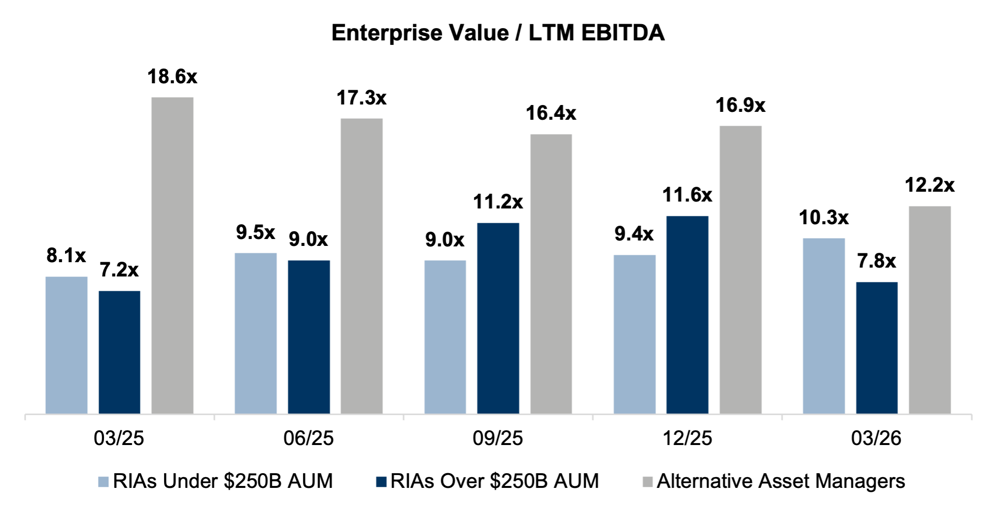
The EV / LTM EBITDA chart does not show a simple size premium, and that is part of the point. Alternative asset managers continue to trade at the highest multiples in the group, while the RIA segment has moved around more but has not followed a clean “bigger is better” pattern. In fact, the latest quarter shows smaller RIAs trading above larger RIAs, which is a useful reminder that the market is paying for more than just scale.
That matters because it suggests investors are still rewarding a combination of earnings visibility, growth consistency, and business mix rather than asset size alone. For smaller and mid-sized managers, that is encouraging. The path forward is not to out-scale the largest firms. It is to compete more selectively, in areas where investors are willing to pay for differentiation, whether that is a specific sector, a more specialized fixed income mandate, or a product structure that better fits how clients want to access the strategy.
The recent inflows to active ETFs is one such opportunity, offering a way to modernize distribution without changing the underlying investment process. Strategic acquisitions remain another, particularly for firms looking to broaden capability or improve operating leverage. And with cost pressure still in the background, the firms that can translate AUM growth into durable earnings growth are the ones most likely to sustain higher valuations over time.
Looking ahead to the remainder of 2026, the outlook is constructive but not uncomplicated. Flows are likely to remain positive, particularly if interest rates stay elevated and continue to support fixed income demand. At the same time, market volatility, geopolitical uncertainty, and evolving investor expectations are unlikely to dissipate.
As flows become more concentrated in specific asset classes and strategies, capturing them becomes increasingly competitive.
Closing Thoughts
The return of inflows is undeniably positive for the asset management industry. But it does not fundamentally change the nature of the business.
Asset management remains a competitive, scale-driven, and increasingly selective industry. The firms that benefit most from this next phase will not simply be those with the largest asset bases, but those best aligned with how and where investors are allocating capital.
Because in today’s environment, growth is no longer just about being in the market. It is about being positioned correctly within it.
About Mercer Capital
We are a valuation firm that is organized according to industry specialization. Our Investment Management Team provides valuation, transaction, litigation, and consulting services to a client base consisting of asset managers, wealth managers, independent trust companies, broker-dealers, PE firms and alternative managers, and related investment consultancies.