
Key Takeaways
RIA M&A activity in early 2026 remains strong but has become more selective, with buyers concentrating on high-quality firms that demonstrate durability rather than just scale.
Private equity continues to dominate deal activity and sustain elevated valuations, though deal structures and long-term growth expectations are increasingly critical to closing transactions.
Strategic priorities across the industry are shifting toward capability expansion, operational scale, and alignment of incentives, with both buyers and sellers placing greater emphasis on fit and long-term outcomes.
RIA M&A activity has carried into 2026, but with a more measured tone than last year’s record-setting pace. Fidelity logged 37 announced RIA transactions through February, 20 in January and 17 in February. That pace is below the 48 deals announced in the first two months of 2025, but it still points to a market that remains active by historical standards. In other words, the market is still moving; it is simply becoming more discerning.
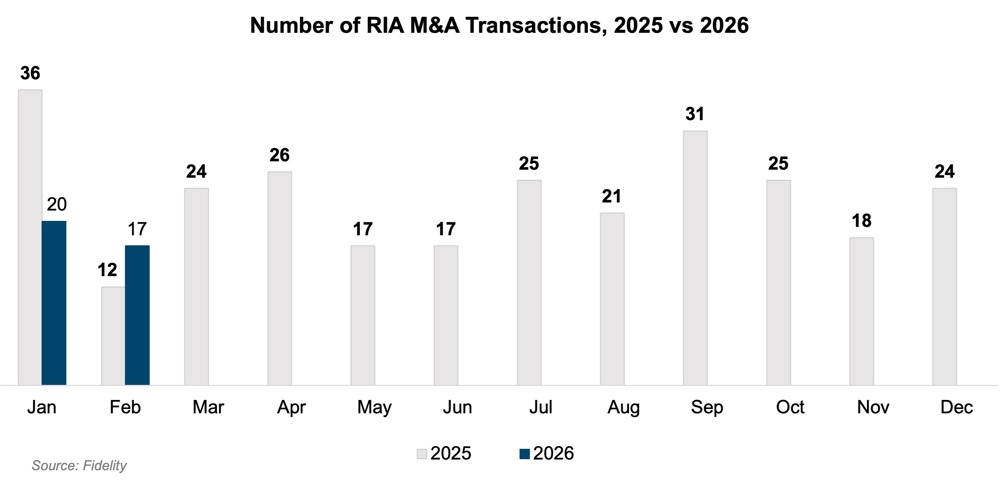
Until fuller first-quarter datasets are published, the early read is that 2026 still looks like a strong year, but a more selective one. The buyer universe may be broadening, yet activity remains concentrated: through February, Beacon Pointe had announced five deals, CAPTRUST three, and both Mariner and Cerity two. The most active platforms still account for a disproportionate share of announced transactions.
The largest announced transactions so far this year reinforce that point. Neuberger Berman’s acquisition of MIO Partners (~$26 billion AUM) sits atop the list, but it is hardly alone. Clearstead’s acquisition of The Clarius Group (~$5.1 billion), CAPTRUST’s acquisitions of Alpha Cubed Investments (~$3.8 billion) and Meritage Portfolio Management (~$2.4 billion), and Cerity’s acquisition of SOL Capital Management (~$3.0 billion) all point to continued demand for scaled, institutional-quality RIAs.
Private Equity and Valuations: Still Driving the Bus
Private equity continues to play a central role in RIA M&A. Fidelity noted that private equity was behind every February deal but one, which is about as clear a signal as any that sponsor capital is still setting the pace.
The math is straightforward. More capital chasing a finite number of high-quality firms leads to competitive processes, flexible deal structures, and a willingness to underwrite future growth. What has changed slightly is how that growth is evaluated.
Today’s buyers are not simply paying for size, they are paying for durability. RIAs that command premium valuations tend to share a few common characteristics:
Consistent organic growth, not just market-driven AUM expansion
A deep leadership bench, reducing key-person risk
Institutional infrastructure, including technology, compliance, and repeatable processes
Expanded service capabilities, particularly in tax, estate, retirement, and family office solutions
Strong client retention and recurring revenue visibility
Deal structure also continues to matter. Equity rollovers, earnouts, and incentive alignment remain common, and in many cases, are necessary to bridge valuation expectations. Equity participation is increasingly viewed less as a concession and more as an opportunity – particularly when sellers believe in the long-term growth of the platform they are joining.
Put differently: headline multiples still make for good conversation, but structure is where deals actually get done.
Both buy-side and sell-side factors remain supportive of M&A activity, though the underlying motivations continue to evolve.
Factors Affecting Willingness to Buy vs. Sell
Buy-Side Factors:
Significant private capital remains available, supporting continued competition for high-quality RIAs.
Buyers are prioritizing firms with durable, organic growth over those reliant on market performance.
Strategic acquisitions are increasingly focused on capability expansion (tax, retirement, family office), not just scale.
Synergies still matter – but “plug-and-play” cultural and operational fits are becoming just as important as cost savings.
Sell-Side Factors:
Succession planning remains a key driver, but it is no longer a binary “sell or don’t sell” decision.
Sellers are increasingly seeking liquidity with continuity – monetizing a portion of their ownership while maintaining involvement.
Access to better technology, marketing, and operational infrastructure continues to be a major motivator.
A broader range of buyer types allows sellers to prioritize fit and structure, not just price.
One notable shift from prior periods: external sales are no longer simply a “last resort” for firms without a succession plan. In today’s market, they are often a proactive strategic decision, one that can solve for growth, succession, and monetization simultaneously.
Broader Industry Themes
A few themes continue to shape the direction of the RIA industry in 2026:
Service expansion is accelerating. RIAs are moving beyond traditional financial planning into more holistic offerings, including tax planning, estate strategies, and family office services.
Operating costs are rising. Firms are investing heavily in technology, talent, and client experience, which is increasing the importance of scale.
Consolidation is becoming more strategic. Buyers are no longer just aggregating assets – they are building platforms.
These trends reinforce a simple reality: scale alone is no longer a differentiator. What you do with scale is what matters.
What Does This Mean for Your RIA?
For RIAs planning to grow through strategic acquisitions: Pricing remains elevated, but selectivity has increased. The risk is not just overpaying – it is overpaying for the wrong kind of growth. Firms that can integrate effectively and drive organic growth post-acquisition will continue to justify premium valuations over time.
For RIAs considering internal transactions: The range of succession structures continues to widen. Succession is no longer a simple internal-versus-external decision. Many firms are weighing both paths at the same time, which increases the importance of next-generation ownership, shared incentives, and sound governance. In that environment, structuring the transition thoughtfully is becoming just as important as pricing it.
For RIAs considering selling: The market remains favorable, but the “best” deal is not always the highest price. With a wide range of buyer models available, sellers should focus on aligning with a partner whose structure, strategy, and culture match their long-term goals. In many cases, the right partner will matter more than the last turn of EBITDA.
About Mercer Capital
We are a valuation firm that is organized according to industry specialization. Our Investment Management Team provides valuation, transaction, litigation, and consulting services to a client base consisting of asset managers, wealth managers, independent trust companies, broker-dealers, PE firms and alternative managers, and related investment consultancies.