
Key Takeaways
RIA M&A activity remained robust through August 2026, with 158 announced transactions, 11% below the same period in 2025 but 13% above 2024 levels. While transaction volume has moderated, continued acquisition activity reflects sustained buyer interest in the sector.
Large transactions disproportionately influenced acquired AUM totals, with two August acquisitions accounting for approximately 80% of the month's reported assets. Smaller RIAs continued to represent the majority of announced deals, highlighting the distinction between headline transaction sizes and broader market activity.
Private equity-backed consolidators and repeat acquirers continue to drive RIA M&A activity, while minority investments provide an alternative to outright sales. For RIA owners, evaluating transaction opportunities requires consideration of valuation, deal structure, retained ownership, governance rights, and post-closing risk.
RIA M&A activity held up through August, although the number of announced transactions trails last year. Our count, built from Fidelity's monthly reports, stands at 158 announced transactions through August 2026, compared with 178 over the same period in 2025 and 140 in 2024. The pace has moderated from last year's high (down about 11%) but remains above 2024 levels (up about 13%).
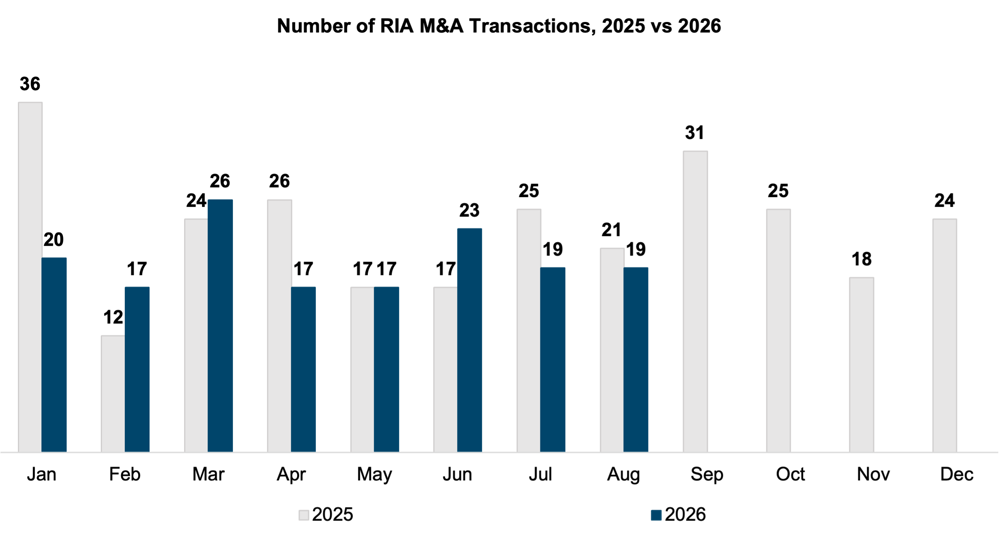
Source: Fidelity's August 2026 transaction report and prior monthly reports. The series retains seven May transactions that appeared in Fidelity's May report but were omitted from its August year-to-date list. September is not reflected.
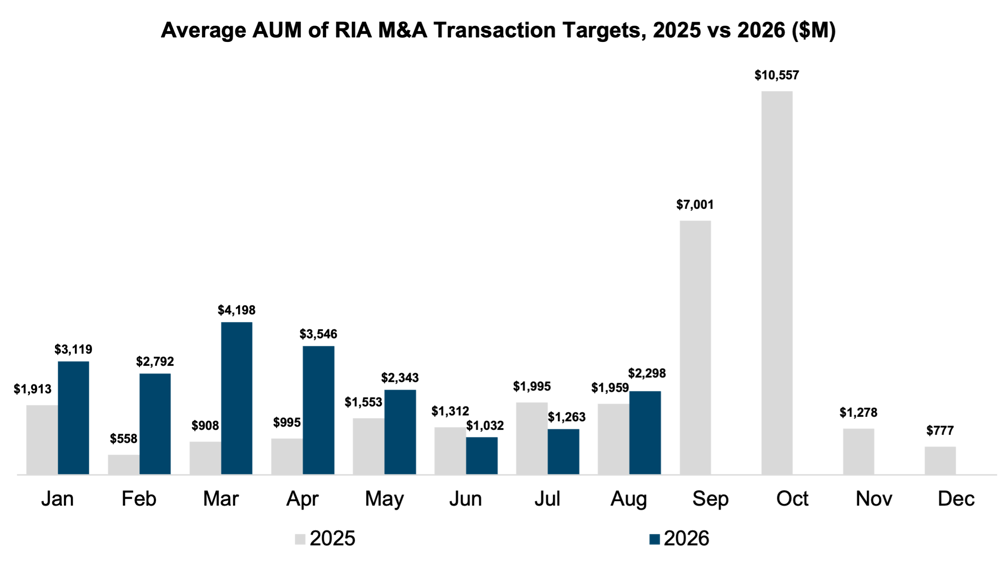
Acquirers seemed to enjoy the summer lull in July and August more than they did a year ago, but we would hardly call 38 announced transactions a vacation. Deal volume eased from 23 in June to 19 in each of July and August, eight fewer over the two months than in the same period of 2025. Acquired assets increased from $24.0 billion in July to $43.7 billion in August, reflecting two large transactions rather than any pickup in the number of deals.
Source: Fidelity
The average AUM of announced targets rose from $1.3 billion in July to $2.3 billion in August. The entire increase came from two transactions: Corient's acquisition of Summit Trail Advisors ($21.0 billion in AUM) and The Vistria Group's acquisition of Curi Capital ($14.0 billion). Together, these two targets represented about 80% of the assets involved in August's 19 listed transactions; excluding them, the average August target was about $510 million, below July's figure. The monthly average is useful for showing the effect of large deals, but less useful as a measure of the typical target. The median August target managed about $550 million, roughly in line with July's median of about $500 million.
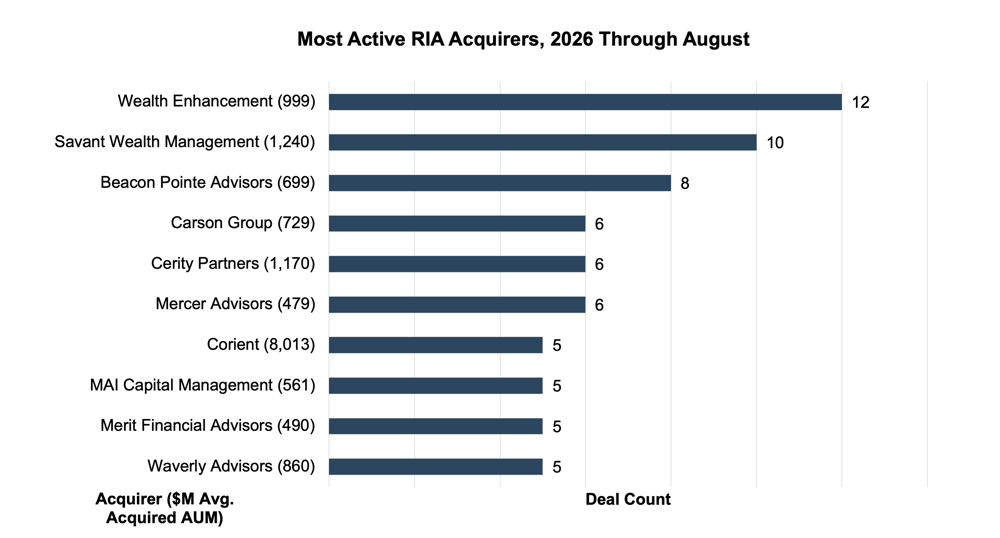
Deal activity remains concentrated among repeat acquirers; Fidelity attributes roughly 90% of August's activity to serial buyers and notes that every August transaction involved a PE-backed acquirer. Wealth Enhancement announced 12 transactions through August, Savant 10, and Beacon Pointe 8. The exhibit below shows the ten most active buyers and the average AUM of their targets. Corient's five transactions included Summit Trail, lifting its average acquired AUM to about $8.0 billion, well above the $0.5 billion to $1.2 billion range for the other frequent buyers.
Source: Fidelity
Small Deals, Large Headlines
Smaller firms continued to account for most announcements. Sixteen of August's 19 targets had less than $1 billion in AUM, as did 13 of the 19 targets in July. The larger transactions generated most of the acquired assets, while smaller acquisitions supplied most of the deal count. Fidelity's report captures only RIA targets with more than $100 million in AUM, so the small end of the market is larger still than these figures suggest.
These measures describe different parts of the market. The monthly average AUM chart captures the influence of large transactions; the buyer exhibit shows which firms have been most active. Neither provides a direct indication of the likely transaction terms for an individual RIA, particularly when its size, growth, client base, and management depth differ from the headline transactions.
Announced AUM also tells us little about transaction pricing. Purchase prices and terms are rarely public, and the value of an advisory firm depends on more than the assets it manages. Organic growth, client retention, margins, leadership depth, and the structure of consideration all affect how a buyer assesses a target.
Minority capital remains an alternative to an outright sale. Fidelity separately identified five minority investments in August, including The Carlyle Group's investment in Prime Capital Financial ($50 billion in AUM) and FTV Capital's investment in Kingsview Partners ($10 billion). The Prime Capital investment alone involved more assets than any control transaction announced in August. These arrangements can provide growth capital or owner liquidity while allowing management to remain in place, although governance rights and exit terms may differ considerably from a full sale.
Owners comparing proposals should look beyond the headline valuation. Upfront cash, retained equity, contingent consideration, control rights, and the eventual exit path can materially change the economics and risk of a transaction.
Three Things Worth Watching
Three things are worth watching over the rest of the year:
Whether September rebounds. September 2025 produced 31 announcements, the second-busiest month of last year after January. A comparable September would narrow the gap to last year's pace; a quiet one would confirm that 2026 is running at a lower level.
Platform-scale sellers. Corient took Seven Bridges ($4.9 billion) in July and Summit Trail ($21 billion) in August, Caprock acquired Venturi ($4.0 billion), and The Vistria Group bought Curi Capital ($14 billion). A firm of that size selling outright is a different transaction from a tuck-in, with different valuation and integration questions, and whether the pipeline of large sellers continues is the question for the fall.
Minority capital at scale. The Prime Capital and Kingsview investments noted above each involved more assets than 17 of August's 19 control transactions. Minority recapitalizations give owners liquidity without a change of control, but the rights retained or transferred need to be weighed alongside the headline valuation.
What Does This Mean for Your RIA?
For buyers: Smaller practices continue to offer acquisition opportunities. The attractiveness of an acquisition ultimately depends on the clients, personnel, economics, and integration requirements behind the reported AUM.
For internal succession: External platform transactions provide market context, but their scale and control terms may have limited direct relevance to an internal transfer of a minority interest.
For sellers: Compare proposals on cash proceeds, retained ownership, future role, and risk after closing. Buyer activity establishes that there is interest in the sector; it does not establish the right terms for a particular firm.
About Mercer Capital
We are a valuation firm organized according to industry specialization. Our Investment Management Team provides valuation, transaction, litigation, and consulting services to asset managers, wealth managers, independent trust companies, broker-dealers, private equity firms, alternative managers, and related investment consultancies.