
Key Takeaways
A buyer’s price is payment for control as well as cash flow, so the highest offers usually come with the most change.
Much of a founder’s role after closing is negotiable, but what is fixed tends to be what made the price possible.
Buyers differ widely in how they use control, and founders who know and can explain what they want to protect are best placed to choose among them.
A ship sailing from New York to San Francisco can go around Cape Horn, a voyage of about 13,000 miles through some of the roughest water in the world, or it can go through the Panama Canal and cut the trip to about 5,200 miles. The shorter route comes with a condition. In most of the world's ports and waterways, a pilot comes aboard to advise and the captain remains in command. In the canal, the pilot takes control of the ship, and the captain who has brought it all the way down the Atlantic steps away from the helm.
No captain enjoys that moment, but most accept it, because the alternative is another 8,000 miles. The shortcut is valuable enough that, when capacity is tight, shippers have paid millions on top of the regular toll to skip the line, including more than $5 million for a single slot in August this year.
Founders face a version of the same choice. We wrote recently about what it costs to stay independent. A sale is the shorter way to the same place, a firm that no longer depends on its founder, and its price is control. A founder who sells will have a partner to answer to in major decisions, often for the first time in many years.
For someone who has built a firm over decades, that is no small thing. In our experience, some part of a sale is difficult for almost every founder, and one who hesitates over it is responding to the real cost of the transaction. It helps to understand why buyers ask for a say in decisions, how much of it is open to negotiation, and how different one buyer can be from another.
What the Price Is For
When a firm goes to market, the offers usually arrive in a wide range. It is natural to read the spread as a difference of opinion about what the business is worth. More often, it reflects different plans for it.
The buyer at the top of the range usually expects to integrate the firm, with common systems, a shared brand, and a growth plan. It can pay more because it expects to do more with what it is buying. The buyer at the bottom may be happy to leave things as they are, and its price reflects that.
Seen this way, a high offer is a compliment that comes with expectations. The buyer is saying that the firm would be worth a great deal in its hands, and it is asking for the control to make that true. Founders hope for the high price and the light touch together. The two rarely come from the same buyer, and each founder must price that tradeoff before signing.
What a Founder Keeps
A founder remains a leader of the firm after closing. A great deal about a founder's place in the firm is open to negotiation, including title, the scope of the role, who the founder reports to, and how much say local leadership has over staffing and client service. Good buyers know that an experienced founder is part of what they are buying, and they leave room accordingly.
What a founder cannot expect is to keep the final say on everything. What is fixed tends to be what made the price possible, since a buyer can pay more for a firm it can run on its own systems and under its own brand. For a founder who has not reported to anyone in decades, giving that up is usually the biggest adjustment in a sale.
The founders who make this adjustment well tend to be those who know and can explain what they most want to protect. For some it is the team, for others the structure of the firm, the way clients are served, or simply the freedom to keep doing the work they enjoy without the parts they don't. Buyers expect to have that conversation, and the good ones welcome it.
Choosing the Buyer
Buyers differ a good deal in how they use the control they acquire, and the founder is the one who chooses among them. An offer that is lower but leaves more decisions with the firm may be the better one for a founder who intends to keep working for another decade. A buyer with an ambitious growth plan will want the founder to stay and help carry it out, which suits a founder who still wants to build and not one who is ready to slow down. A higher offer with more integration may suit a founder who is ready to hand off management and wants the firm's people to have a larger platform.
The best guide to how a buyer will work with a founder is how it has worked with others before. Founders who have already sold to that buyer are usually willing to talk, and they can say how often they and the buyer disagreed, how it was resolved, and whether the role they were promised turned out to be the role they got. Those conversations say more about life after closing than any org chart.
A sale process takes several months, and an internal transition can take decades. Ships still go the long way around Cape Horn, and the largest of them, which the industry calls Capesize, are too big for the canal and are built for the voyage. The third route that sailors spent four hundred years looking for, through the Arctic, is navigable for a brief time in summer, in years the ice allows.
The canal gets a ship to the Pacific sooner, and the cape gets it there under its own command. The ship waiting for the ice to clear is still in the Atlantic.
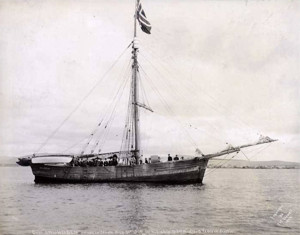
The exception: Roald Amundsen’s Gjøa, the first through the ice, at Nome, Alaska in 1906. With a crew of six, she left Norway in June 1903, spent most of the next three years frozen in place, and reached San Francisco in 1906, three winters older. The way home was around Cape Horn. Amundsen sold her.