EXECUTIVE SUMMARY
It is common for businesses, real estate, marketable securities, and other assets to be held through multiple layers of entities. A limited partnership or LLC might own a minority interest in a private operating company and the interest being transferred may be a nonvoting interest in the holding entity. At the outset, this seems straightforward: value the underlying operating company, multiply by the holding entity’s ownership percentage, and multiply again by the percentage of the holding entity transferred.
Fair market value, however, is not simply multiplication with more steps. Each tier shapes the rights, cash flows, risks, and exit paths available to the hypothetical buyer of each interest. The practical question is not how many layers appear on the organization chart but whether the differences at each tier support a separate valuation adjustment at each layer.
This article examines that question through an analysis of Nelson v. Commissioner, focusing on the Tax Court’s treatment of discounts at each successive ownership tier and the evidence supporting those discounts. The Nelson case illustrates a central principle: additional tiers of ownership call for additional analysis; they do not create automatic discounts.
Start with the Structure and the Interest Being Valued
A tiered valuation begins by identifying the pieces in play. First is the underlying business or asset. Second is rights and economics at each entity layer. Third is the ownership interest being transferred at each layer. Each layer may ultimately derive value from the same source, but they are not the same property. In practice, the underlying asset and the subject interest may be several tiers removed from each other.
At each level, the appraiser should identify voting and consent rights, authority over distributions, transfer restrictions, redemption or put rights, information rights, and realistic exit routes. A discount for lack of control addresses the holder’s inability to direct decisions such as distributions, management, financing, asset sales, or liquidation. A discount for lack of marketability addresses the difficulty, cost, delay, and uncertainty involved in converting the interest to cash. Those limitations can interact across tiers, but they should not be blurred together.
The analysis also has to keep score. If the value assigned to the holding entity’s underlying investment already reflects that investment’s lack of control or marketability, the upper-tier analysis should begin from that value. Any further adjustment should capture a separate limitation borne by the buyer of the transferred interest. Without that bridge, a second discount may merely rename an impairment already reflected at a lower tier of the valuation.
Nelson as a Practical Example
Nelson v. Commissioner provides a useful example. Longspar Partners, Ltd., a family limited partnership formed in 2008, owned 65,837 shares (approximately 27%) of Warren Equipment Co (WEC). WEC was itself a holding company with seven operating subsidiaries. WEC common stock represented approximately 99% of Longspar’s asset value. The transferred property was limited partner interests in Longspar.
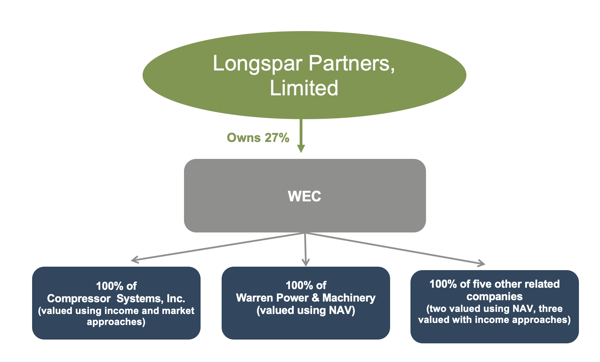
The valuations proceeded in sequence. The experts first valued the WEC shares, including the rights and restrictions attached to the noncontrolling, nonmarketable investment. That value flowed into Longspar’s net asset value along with its other assets and liabilities. The experts then valued the transferred Longspar limited partner interests, considering the rights and limitations at the Longspar partnership level.
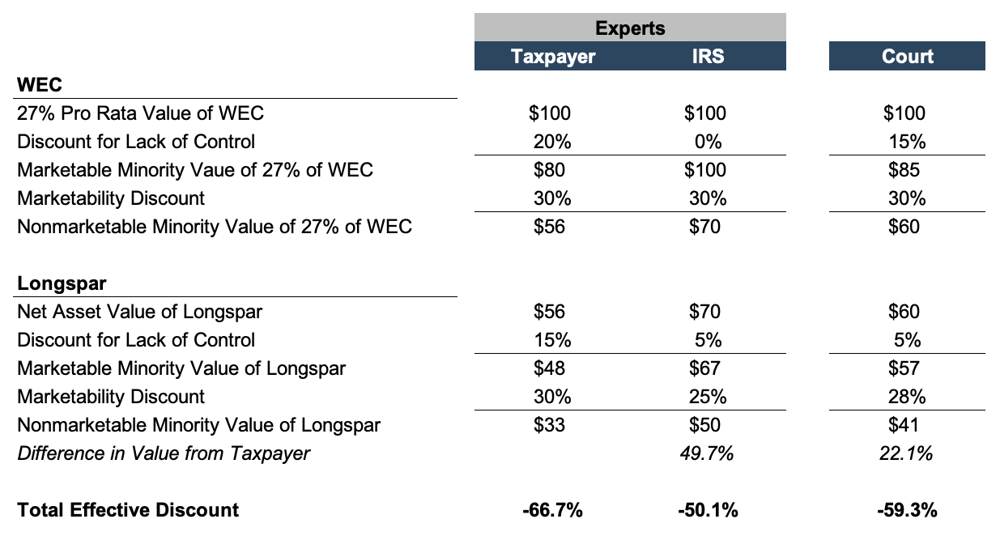
The Tax Court ultimately applied a 15% discount for lack of control and a 30% marketability discount to WEC common stock. It then applied a separate 5% discount for lack of control and 28% marketability discount to the Longspar limited partner interests. The percentages are not a template for other structures. Their importance is analytical: the Court evaluated the property at each tier and considered whether the upper-tier interest introduced incremental constraints.
Level of Value Determines the Necessary Bridge
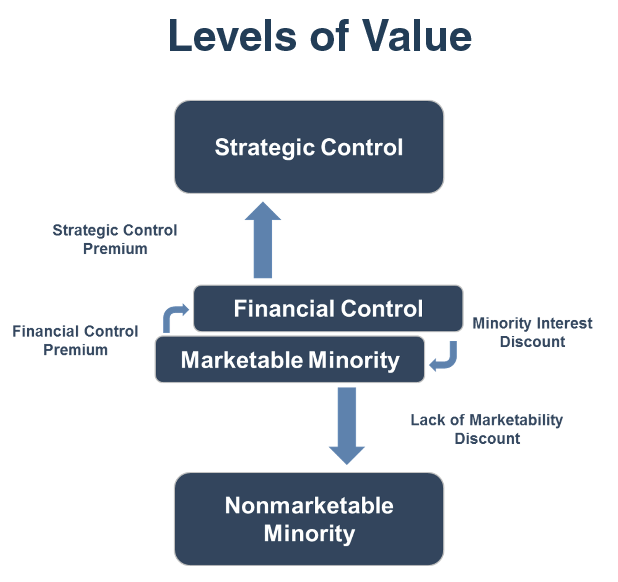
Before quantifying the discount, the appraiser must identify the level of value produced by the underlying analysis. Financial control value reflects the cash flows and policies available to a controlling owner on a standalone basis, excluding buyer-specific synergies. Marketable minority value reflects a noncontrolling interest that can be readily traded, similar to public-company shares. Nonmarketable minority value removes the access to a ready market. The figure below summarizes the levels of value used by business appraisers.
The conceptual bridge is straightforward: financial control value multiplied by one minus the discount for lack of control equals marketable minority value and marketable minority value multiplied by one minus the discount for lack of marketability equals nonmarketable minority value. The sequence also shows why the discounts are multiplicative rather than additive.
The selected valuation method does not, by itself, answer the “level of value” question. A discounted cash flow analysis based on existing policies may produce a noncontrolling indication, while one that reflects changes available to a controlling owner may indicate financial control value or even a strategic control value.
Guideline public company multiples generally begin at a marketable minority level. An adjusted net asset value analysis often indicates control when it captures all assets at their highest and best use, but its assumptions still must be examined.
This distinction was central to the WEC dispute in Nelson. The taxpayers’ expert characterized the $1,532 per share starting value as controlling and applied a 20% discount for lack of control. The IRS expert argued that the subsidiary values were already noncontrolling, making another discount for lack of control duplicative. The Court found that most component valuations contained at least some elements of control, although not all methods produced controlling values, and selected a 15% discount. The question was not simply whether a WEC shareholder lacked control. It was how much of that disadvantage remained to be reflected after establishing the starting value.
Marketability and the Importance of Multiple Methods
The experts also took different approaches to Longspar’s marketability discount. The taxpayers’ expert relied on restricted stock and pre-IPO studies, finding average discounts of 30% to 40% in the restricted stock studies and 40% to 45% in the pre-IPO studies. He selected 30%. The Court found that approach unpersuasive because it depended on studies the Court had previously declined to use for long-term closely held investments.
The IRS expert used a broader set of tools. Quantitative models, including an analysis of a protective put option, produced a range of 22% to 34%. More recent restricted stock and pre-IPO data produced a range of 20% to 35%. He reconciled those indications at 25%, reasoning in part that Longspar’s discount should be incrementally lower than WEC’s because WEC’s marketability limitations were already reflected in the value of Longspar’s principal asset. The table below uses example numbers for the values of Longspar and WEC, to show the impact of these different discount treatments.
The Court preferred the broader analysis, but it did not simply accept the conclusion of the IRS’s expert. It agreed that avoiding overlap with the WEC discount was a reasonable consideration, yet found no support for selecting 25% beyond the expert’s statement that it represented the middle of the ranges. The Court observed that the median was 28% and adopted that figure instead.
The lesson is not that two methods are always better than one. Multiple methods can make an analysis more resilient when they test the subject interest from different angles, use data relevant to the valuation date, and are reconciled to the interest’s expected cash flows, holding period, restrictions, and exit prospects. The reconciliation still has to explain why the selected data point fits the characteristics of the subject interest.
Lack of Control and the Limits of Familiar Datasets
The analysis of the discount for lack of control carries a related warning. Both experts used closed-end fund data to estimate a lack of control discount for Longspar. The taxpayers’ expert selected three nondiversified funds and proposed 15%. The IRS expert reviewed 30 general equity funds, concluded that none was truly comparable to Longspar, and proposed 5% after making further judgmental reductions.
The Court rejected both analyses, believing that closed-end funds were not sufficiently comparable to Longspar. It nevertheless agreed that a minority owner could face a control disadvantage, considered that possibility remote, and selected 5%. Rather than a blanket rejection of closed-end fund evidence, the Court’s decisions was a rejection of the connection drawn between those funds and this partnership.
A familiar dataset is only a starting point. If possible, the appraiser should connect the benchmark to the subject interest’s voting rights, distribution influence, asset concentration, investment mandate, manager discretion, size, expenses, and other economic characteristics. When the comparables are few or imperfect, the explanation of differences and adjustments becomes more important.
Practical Implications for Estate Planners
Tiered structures are easier to analyze when the planning and appraisal files tell the same story. A complete ownership chart should identify every entity, class, percentage, and control threshold. Governing agreements, amendments, shareholder agreements, side letters, and buy-sell provisions should be available for each tier. Counsel may need to advise whether a restriction is enforceable or respected for transfer tax purposes; the appraiser evaluates its economic effect.
The appraisal should then trace control, distributions, and liquidity through the structure. Who can cause or block a distribution? Can cash received from the underlying company be retained at the holding entity? Can the subject holder transfer the interest, compel redemption, participate in a sale, or access information? What buyer pool and holding period are realistic? These questions reveal whether the next tier creates a new economic disadvantage or merely repeats one already priced into the underlying investment.
Finally, the report should reconcile its methods and its judgment. It should identify overlap between adjustments already embedded in asset values and those proposed at the subject-interest level, describe the incremental risk supporting each additional adjustment, and explain why the selected discount is reasonable within the indicated range. A conclusion is more persuasive when a reader can follow the path from documents, to rights, to economics, to methods, and then to the final selection. The appraisal report should be a guided tour, not a maze of jumbled valuation inputs.
Conclusion
From the investor’s perspective, an additional entity layer matters only if it changes the investment. It may separate the holder further from operating decisions, interrupt the flow of distributions, narrow the available buyers, lengthen the expected holding period, or make an exit more costly and uncertain. Or it may add little beyond a legal wrapper.
A valuation that is comprehensive and well-reasoned makes that distinction explicit. It identifies the property at each tier, carries forward the limitations already reflected in value, and supports only the incremental economic disadvantages borne by the buyer of the transferred interest. Nelson illustrates both sides of the discipline: multiple ownership tiers can support multiple layers of adjustment, but familiar datasets and professional judgment still require a fact-specific bridge to the conclusion. In a tiered structure, the methods matter, but so does the judgment that connects them, layer by layer.