Corporate Valuation

July 24, 2020

A “Grievous” Valuation Error: Tax Court Protects Boundaries of Fair Market Value in Grieve Decision

All fair market determinations involve assumptions regarding how buyers and sellers would behave in a transaction involving the subject asset. In a recent Tax Court case, the IRS appraiser applied a novel valuation rationale predicated on transactions that would occur involving assets other than the subject interests being valued. In its ruling, the Court concluded that this approach transgressed the boundaries of what may be assumed in a valuation.

Background

At issue in Grieve was the fair market value of non-voting Class B interests in two family LLCs.

  • The first, Rabbit, owned a portfolio of marketable securities having a net asset value of approximately $9 million.
  • The second, Angus, owned a portfolio of cash, private equity investments, and promissory notes having a net asset value of approximately $32 million.
Both Rabbit and Angus were capitalized with Class A voting and Class B non-voting interests. The Class A voting interests comprised 0.2% of the total economic interest in each entity. The Class A voting interests were owned by the taxpayer’s daughter, who exercised control over the investments and operations of the entities.

Valuation Conclusion – Taxpayer

The taxpayer measured the fair market value of the Class B non-voting interests using commonly accepted methods for family LLCs.

  •  The net asset value of each LLC was deemed to represent the value on a controlling interest basis.
  • Since the subject Class B non-voting interests did not possess control over either entity, the net asset value was reduced by a minority interest discount. The taxpayer estimated the magnitude of the minority interest discount with reference to studies of minority shares in closed end funds.
  • Unlike the minority shares in closed end funds, there was no active market for the Class B non-voting interests in Rabbit and Angus. As a result, the taxpayer applied a marketability discount to the marketable minority indication of value. The taxpayer estimated the marketability discount with reference to restricted stock studies.
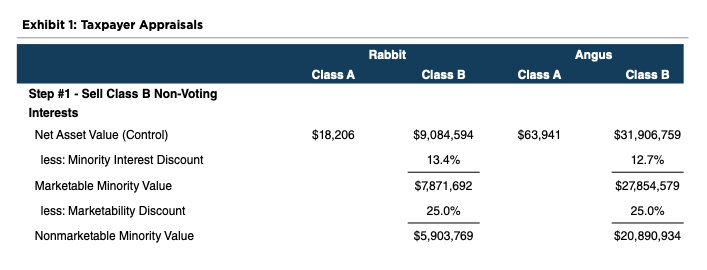
The combined valuation discount applied to the Class B nonvoting interests was on the order of 35% for both Rabbit and Angus, as shown in Exhibit 1.

Valuation Conclusion – IRS

The IRS adopted a novel approach for determining the fair market value of the Class B non-voting interests.

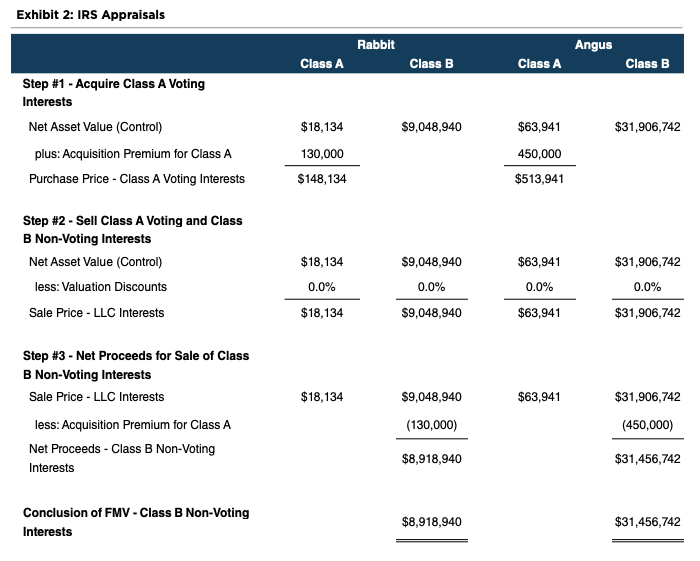
Noting the disparity in economic interests between the Class A voting (0.2%) and Class B non-voting interests (99.8%), the IRS concluded that a hypothetical willing seller of the Class B non-voting interest would sell the subject interest only after having first acquired the Class A voting interest. Having done so, the owner of the class B non-voting interest could then sell both the Class A voting and Class B nonvoting interests in a single transaction, presumably for net asset value.

If the dollar amount paid of the premium paid for the Class A voting interest is less than the aggregate valuation discount applicable to the Class B non-voting interest, the hypothesized series of transactions would yield more net proceeds than simply selling the Class B non-voting interest by itself. The sequence of transactions assumed in the IRS determination of fair market value is summarized in Exhibit 2.
Tax Court Conclusion

It is certainly true that – if the Class A voting interests could, in fact, be acquired at the proposed prices – the sequence of transactions assumed by the IRS yield greater net proceeds for the owner of the subject Class B non-voting interests than a direct sale of those interests. However, is the assumed sequence of transactions proposed by the IRS consistent with fair market value?

The Tax Court concluded that the IRS valuation over-stepped the bounds of fair market value. The crux of the Court’s reasoning is summarized in a single sentence from the opinion: “We are looking at the value of the Class B Units on the date of the gifts and not the value of the class B units on the basis of subsequent events that, while within the realm of possibilities, are not reasonably probable, nor the value of the class A units.” Citing a 1934 Supreme Court decision (Olson), the Tax Court notes that “[e]lements affecting the value that depend upon events within the realm of possibility should not be considered if the events are not shown to be reasonably probable.” In view of the fact that (1) the owner of the Class A voting interests expressly denied any willingness to sell the units, (2) the speculative nature of the assumed premiums associated with purchase of those interests, and (3) the absence of any peer review or caselaw support for the IRS valuation methodology, the Tax Court concluded that the sequence of transactions proposed by the IRS were not reasonably probable. As a result, the Tax Court rejected the IRS valuations.

The Grieve decision is a positive outcome for taxpayers. In addition to affirming the propriety of traditional valuation approaches for minority interests in family LLCs, the decision clarified the boundaries of fair market value, rejecting a novel valuation approach that assumes specific attributes of the subject interest of the valuation that do not, in fact, exist. As the Court concluded, fair market value is determined by considering the motivations of willing buyers and sellers of the subject asset, and not the willing buyers and sellers of other assets.


Originally appeared in Value Matters™, Issue No. 3, 2020

Continue Reading

April 2026 | Valuation Date Discipline
Value Matters® April 2026

Valuation Date Discipline

In estate and gift tax related business valuation, few inputs are as consequential, and as frequently underestimated, as the valuation date. While the concept appears straightforward, the practical implications are anything but. The valuation date determines the universe of information available to the appraiser, frames the applicable standard of value, and anchors the conclusion in a specific economic, industry, and subject company context.
Mercer Capital to Sponsor The 32nd Annual Advanced Estate Planning Strategies Course
Mercer Capital is proud to sponsor the 32nd Annual Advanced Estate Planning Strategies course, a live, in-person CLE event held April 23-24, 2026, at the St. Julien Hotel & Spa in Boulder, Colorado. Representing the firm at the event are J. David Smith, CFA, ASA, and Barbara Walters Price.Presented by TexasBarCLE and cosponsored by the Real Estate, Probate & Trust Law Section of the State Bar of Texas, the course brings together attorneys and advisors for two days of in-depth discussion on advanced estate planning topics. The program features sessions addressing retirement benefits planning under SECURE 2.0, life insurance strategies, multijurisdictional planning considerations, and approaches to minimizing conflict in estate and trust administration.Attorneys attending the course will be focused on navigating increasingly technical planning issues, from evolving transfer tax rules to the practical challenges of administering complex estates. Mercer Capital regularly supports these efforts through valuation analyses used in estate and gift tax planning, charitable giving, and ownership transitions, helping clients and their advisors make informed decisions in high-stakes situations.J. David Smith is a Senior Vice President at Mercer Capital with more than 25 years of experience in business valuation. He provides valuation services for tax planning, transactional purposes, and financial reporting with particular experience in industries including financial services, oil and gas, and biotechnology.Barbara Walters Price serves as Chief Marketing Officer of Mercer Capital and is a member of the firm’s Board of Directors. She leads the firm’s marketing strategy and oversees corporate communications, business development, digital strategy, and thought leadership initiatives.Mercer Capital looks forward to connecting with attendees and contributing to the discussions at this year’s event. To learn more about this in-person CLE course, visit TexasBarCLE’s website: https://www.TexasBarCLE.com/new/?TransferTo=L23823.
Mercer Capital to Sponsor and Attend the 13th Annual Florida Tax Institute
Mercer Capital is pleased to sponsor the 13th Annual Florida Tax Institute, which will be held April 8–10 at The Ritz-Carlton Orlando, Grande Lakes in Orlando, Florida. Tim Bronza, CPA, ASA; Tom Insalaco, CFA, ASA; and Barbara Price will attend on behalf of the firm.More than a conference, the Florida Tax Institute is widely recognized as a leading educational forum for attorneys, accountants, trust officers, estate planners, and financial advisors. This year’s program features nationally respected speakers addressing timely developments in federal and state taxation, estate and gift tax planning, business tax matters, and emerging regulatory considerations. Sessions are designed to offer practical insights that professionals can apply directly in their client work.Tim Bronza serves as Managing Director of Mercer Capital’s Florida office. He has extensive experience valuing business interests for federal gift, estate, and income tax purposes and leads sophisticated valuation engagements across corporate and fiduciary contexts.Tom Insalaco is a Senior Vice President in Mercer Capital’s Florida office. Since 2008, Tom has performed valuation analyses across a broad range of industries, assisting attorneys, fiduciaries, and financial professionals with estate planning, exit planning, and transaction-related matters.Barbara Walters Price serves as Chief Marketing Officer of Mercer Capital and is also a member of the firm’s Board of Directors. She leads the firm’s marketing strategy and oversees corporate communications, business development, digital strategy, and thought leadership initiatives.Mercer Capital’s sponsorship reflects the firm’s ongoing commitment to supporting the tax and estate planning communities in Florida and beyond. Learn more about the event at https://www.floridataxinstitute.org/

Cart

Your cart is empty