Transaction Advisory, Investment Management

April 22, 2019

Q1 2019 Asset Manager M&A Trends

On the Heels of a Record Year, Will Asset Manager M&A Trends Continue to be Strong in 2019?

Last year marked the busiest year for asset manager M&A in the last decade, and the trend is poised to continue into 2019 as business fundamentals and consolidation pressures continue to drive deal activity.

Several trends which have driven the uptick in sector M&A in recent years have continued into 2019, including increasing activity by RIA aggregators and rising cost pressures.  Total deal count during the first quarter of 2019 was flat compared to the same period in 2018, while deal count was up 35% for the twelve months ending March 31, 2019, compared to the comparative period ending March 31, 2018.  Reported deal value during the first quarter of 2019 was down significantly, although the quarterly data tends to be lumpy and many deals have undisclosed pricing.
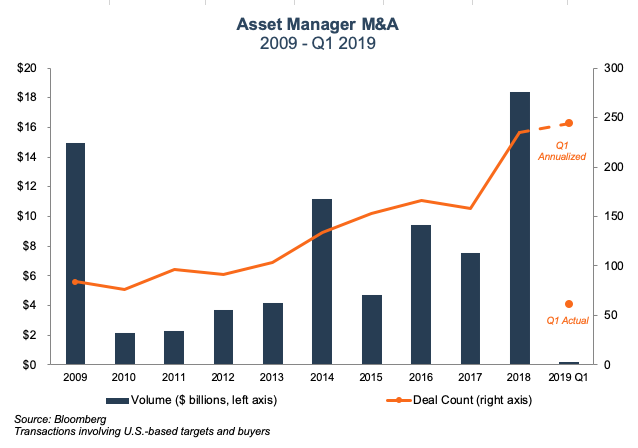
2018 marked the busiest year for asset manager M&A in the last decade, and the trend is poised to continue into 2019.

Consolidation has been a driver of many of the recent large deals, as exemplified by the largest deal of last year, Invesco’s (IVZ) acquisition of OppenheimerFunds.  IVZ announced plans in the fourth quarter last year to acquire the OppenheimerFunds unit from MassMutual for $5.7 billion in one of the largest sector deals over the last decade.  IVZ will tack on $250 billion in AUM as a result of the deal, pushing total AUM to $1.2 trillion and making the combined firm the 13th largest asset manager by AUM globally and the 6th largest by retail AUM in the US.  The deal marks a major bet on active management for IVZ, as OppenheimerFunds’s products are concentrated in actively-managed specialized asset classes, including international equity, emerging market equities, and alternative income.  Invesco CEO Martin Flanagan explained the rationale for scale during an earnings call in 2017:

"Since I've been in the industry, there's been declarations of massive consolidation.  I do think though, this time there are a set of factors in place that weren't in place before, where scale does matter, largely driven by the cost coming out of the regulatory environments and the low rate environments in cyber and alike."  Martin Flanagan – President and CEO, Invesco Ltd. 1Q17 Earnings Call

RIA aggregators continued to be active acquirers in the space, with Mercer Advisors (no relation), and United Capital Advisors each acquiring multiple RIAs during 2018.  The wealth management consolidator Focus Financial Partners (FOCS) has been active since its July IPO as well.  So far in 2019, FOCS has announced 11 deals (including acquisitions by its partner firms).  Just last week, Silvercrest Asset Management announced the acquisition of Cortina Asset Management, a $1.7 billion small cap growth equity manager based in Milwaukee, Wisconsin.

Consolidation Rationales

The underpinnings of the M&A trend we’ve seen in the sector include increasing compliance and technology costs, broadly declining fees, aging shareholder bases, and slowing organic growth for many active managers.  While these pressures have been compressing margins for years, sector M&A has historically been muted, due in part to challenges specific to asset manager combinations, including the risks of cultural incompatibility and size impeding alpha generation.  Nevertheless, the industry structure has a high degree of operating leverage, which suggests that scale could alleviate margin pressure as long as it doesn’t inhibit performance.

"Absolutely, this has been an elevated period of M&A activity in the industry and you should assume … we're looking at all of the opportunities in the market." Nathaniel Dalton, CEO, Affiliated Managers Group Inc – 2Q18 Earnings Call
"Increased size will enable us to continue to invest in areas that are critical to the long-term success of our platform, such as technology, operations, client service and investment support, and to leverage those investments across a broader base of assets." David Craig Brown, CEO & Chairman, Victory Capital – 3Q18 Earnings Call

Consolidation pressures in the industry are largely the result of secular trends.  On the revenue side, realized fees continue to decrease as funds flow from active to passive.  On the cost side, an evolving regulatory environment threatens increasing technology and compliance costs.  Over the past several years, these consolidation rationales have led to a significant uptick in the number of transactions as firms seek to realize economies of scale, enhance product offerings, and gain distribution leverage.

From the buyer’s perspective, minority interest deals ensure that management remains incented to continue to grow the business after the deal closes.

Another emerging trend that has been driving deal volume is the rise of minority interest deals by private equity or strategic buyers.  These deals solve or mitigate many of the problems associated with acquisitions of what are normally “owner operated” businesses (at least for smaller RIAs).  Minority interest deals allow sellers to monetize a portion of their firm ownership (often a significant portion of their net worth).  From the buyer’s perspective, minority interest deals ensure that management remains incented to continue to grow the business after the deal closes.

Market Impact

Deal activity in 2018 was strong despite the volatile market conditions that emerged in the back half of the year.  So far in 2019, equity markets have largely recovered and trended upwards.  Publicly traded asset managers have lagged the broader market so far in 2019, suggesting that investor sentiment for the sector has waned after the volatility seen at year-end 2018.

M&A Outlook

With over 11,000 RIAs currently operating in the U.S., the industry is still very fragmented and ripe for consolidation.  Given the uncertainty of asset flows in the sector, we expect firms to continue to seek bolt-on acquisitions that offer scale and known cost savings from back office efficiencies.  Expanding distribution footprints and product offerings will also continue to be a key acquisition rationale as firms struggle with organic growth and margin compression.  An aging ownership base is another impetus.  The recent market volatility will also be a key consideration for both sellers and buyers in 2019.

Continue Reading

Eagle Ford – 2017/2018 Acquisition & Divestiture Commentary (1)
Eagle Ford – 2017/2018 Acquisition & Divestiture Commentary
Transaction activity in the Eagle Ford Shale has been fairly steady over the past 12 months, with the majority of transactions in the $100-300 million range.  The seller’s rationale has most often been about balance sheet management and re-allocation to other plays, usually the Permian Basin.  However, the Eagle Ford area has some quality economics of its own, which has been attractive to buyers.  Many argue it has the best shale production economics in the U.S. next to the Permian Basin.  These differing strategy based swaps have been at the heart of transaction flow.  This has also led to consideration that Devon may sell its Eagle Ford division in search of returns elsewhere.  The chart below, drawn from Mercer Capital’s newsletter, shows some details in regards to the transactions including some comparative valuation metrics.Magnolia – Blank Check Company forms a New South Texas ProducerThe largest transaction in the past year was the recent announcement of a special purpose acquisition entity (“SPAC”) coming to an agreement with certain Enervest controlled funds.  The result of the merger is the creation of a pure play Eagle Ford and Austin Chalk company with 360,000 net acres in South Texas.   The majority of that acreage is in what is known as the Giddings field which is an oil play in the Austin Chalk (mostly held by production).Break-evens are claimed to be in the low $30’s per barrel with one year (or less) paybacks in Karnes and Giddings field.  Magnolia1 is led by a former Occidental Petroleum executive, Steve Chazen, who has both short and long-term optimism for the opportunity.  Estimated EBITDA for 2018 is projected at $513 million including approximately $240 million of cash flow after capital expenditures.Highest and Best EconomicsDenver-based Sundance Energy Australia Ltd. struck a deal with Pioneer Natural Resource Co. to buy almost 22,000 acres and 1,800 boe/d of production in the Eagle Ford Shale, bolting on to an existing leasehold in South Texas.The pure-play Eagle Ford player agreed to pay $221.5 million for the leasehold, which runs through McMullen, Atascosa, LaSalle and Live Oak counties. The transaction would give Sundance 56,600 total acres in the play, with an inventory of 716 gross undrilled locations.Meanwhile, Pioneer was exiting to focus on the Permian Basin.  Pioneer announced in February it would put most of its resources going forward into the Permian and planned to sell nearly all “non-Permian” projects, including in the Eagle Ford, Raton Basin, and West Texas Panhandle.  The table below demonstrates why its desire to focus on the Permian was warranted.  However, one thing to note is that purchasing acreage in the Permian is much more expensive than the Eagle Ford, so drilling most likely needs to be based on existing acreage positions. Overall, the Eagle Ford’s economics are improving (Venado – a KKR backed Austin firm, made a $765 million purchase from Cabot that was based on this optimism). About 61,500 net acres of the Venado position, which is located primarily in Frio and Atascosa counties in South Texas, is operated and about 9,400 net acres are non-operated. Production from the properties during third-quarter 2017 was 15,656 barrels of oil equivalent per day. An interesting discussion on this acquisition can be found in this video: ?? Have a great week! Endnote1 In case one was wondering - Chip and Joanna Gaines are not involved.
Bankruptcy: An Overview Part 3 (1)
Bankruptcy: An Overview Part 3
From January through May of this year, 39 E&P companies and 31 oilfield services companies had to file for bankruptcy. This post is the last in a series of three aimed at helping those companies, and any others who may face bankruptcy in the future, to understand the valuation-related aspects of Chapter 11 restructuring. In the first post we highlighted two reorganization requirements tied to valuation. First, the plan should demonstrate that the economic outcomes for the consenting stakeholders are superior under the Chapter 11 proceeding compared to a Chapter 7 proceeding. Second, upon confirmation by the bankruptcy court, the plan must not be likely to result in liquidation or further reorganization. In the second post we explored in depth the consequences of the first requirement. Here we examine the importance of the second requirement.Cash-Flow TestFor a company that has followed the steps explained in the previous post, this second requirement represents the last valuation hurdle to successfully emerging from Chapter 11 restructuring. Even if a company shows that the restructuring plan will benefit stakeholders more than liquidation will, the court will still reject the plan if it is likely to lead to liquidation or further restructuring in the foreseeable future. To satisfy the court, a cash-flow test is used to analyze whether the restructured company would generate enough cash to consistently pay its debts. This cash-flow test can be broken into three parts.The first step in conducting the cash-flow test is to identify the cash-flows that the restructured company will generate. These cash-flows are available to service all the obligations of the emerging entity. Remember the discussion in the second post—a stream of cash-flows is developed using the DCF method in order to determine the reorganization value. Thus, in practice, establishing the appropriate stream of cash-flows for the cash-flow test is often a straightforward matter of using these projected cash-flows in the new model.Once the fundamental cash-flow projections are incorporated, analysts then model the negotiated or litigated terms attributable to the creditors of the emerging entity. This involves projecting interest and principal payments to the creditors, including any amounts due to providers of short term, working capital facilities. These are the payments for each period that the cash-flow generated up to that point must be able to cover in order for the company to avoid another bankruptcy.The cash-flows of the company will not be used only to pay debts, and so the third and final step in the cash-flow test is documenting the impact of the net cash-flows on the entire balance sheet of the emerging entity. This entails modeling changes in the company’s asset base as portions of the expected cash-flows are invested in working capital and capital equipment; and modeling changes in the debt obligations of and equity interests in the company as the remaining cash-flows are disbursed to the capital providers. A reorganization plan is generally considered viable if such a detailed cash-flow model indicates solvent operations for the foreseeable future.ConclusionAlthough the Chapter 11 process can seem like no more than a burden, a rigorous assessment of cash-flows and a company’s capital structure can help the company as it tries to develop a plan for years of future success. We hope that these past three posts explaining the key valuation-related steps of a Chapter 11 restructuring help managers realize this potential.However, we also understand that executives of oil and gas companies going through a Chapter 11 restructuring process need to juggle an extraordinary set of additional responsibilities—evaluating alternate strategies, implementing new and difficult business plans, and negotiating with various stakeholders. Given executives’ multitude of other responsibilities, they often decide that it is best to seek help from outside, third party specialists. Valuation specialists can relieve some of the burden from executives by developing the valuation and financial analysis necessary to satisfy the requirements for a reorganization plan to be confirmed by a bankruptcy court. Specialists can also provide useful advice and perspective during the negotiation of the reorganization plan to help the company emerge with the best chance of success. With years of experience in both oil and gas, and in bankruptcy, at Mercer Capital, we are well positioned to help in both of these roles. For a confidential conversation about bankruptcy proceedings and how we can help, please contact a Mercer Capital professional.
Does AI Spending Increase an RIA’s Value-or Just Reduce Its EBITDA?
Does AI Spending Increase an RIA’s Value - or Just Reduce Its EBITDA?
AI investment can create value for RIAs by improving capacity, growth, efficiency, and risk management, but the benefits must ultimately translate into stronger cash flow or reduced risk. Recurring AI costs generally remain operating expenses, making measurable adoption and returns critical to valuation.

Cart

Your cart is empty