 Source: Bloomberg[/caption]
I was thinking about Focus Financial last week when I found myself in traffic behind a Hummer H1. The H1 was the original Hummer, built by AM General based on their military vehicle, the Humvee. An H1 is immense, weighing in at about 8,000 pounds. H1s were capable of climbing boulders and steep grades and fording streams and rivers as deep as 30 inches. Because of these extreme characteristics, the public initially overlooked how difficult the vehicle was to park, maintain, and even keep fueled. Sales of the H1 peaked in the mid-90s. In 1998 GM bought the brand and started producing a more civilian variant, the H2, and then an even smaller (albeit still very large) H3. About a decade later, GM gave up as the public lost interest. Hummer executives must have been frustrated when the media lampooned their products for being ungainly and inefficient. After all, Hummer never pretended to be anything else.
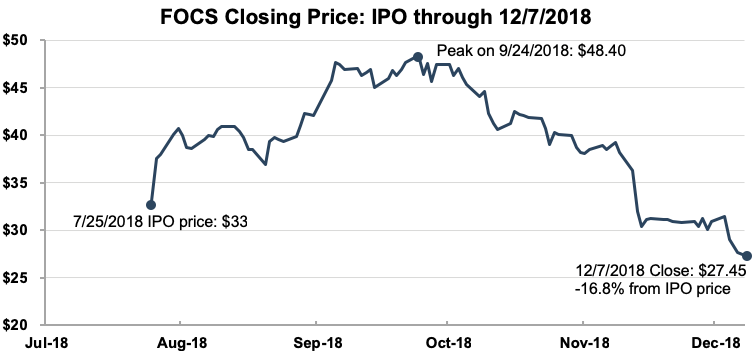
I sensed a similar frustration in Rudy Adolf’s voice last week as he pleaded Focus Financial’s case at the Goldman Sachs U.S. Financial Service Conference. The recent share price performance of Focus clearly suggests the market is losing interest in the issue, and it doesn’t seem to have anything to do with Brexit or yield curve inversions. Instead, the analyst community seems to have soured on the Focus story, which is strange to us because the story hasn’t really changed since the company filed the first version of its S-1 back in May.
Source: Bloomberg[/caption]
I was thinking about Focus Financial last week when I found myself in traffic behind a Hummer H1. The H1 was the original Hummer, built by AM General based on their military vehicle, the Humvee. An H1 is immense, weighing in at about 8,000 pounds. H1s were capable of climbing boulders and steep grades and fording streams and rivers as deep as 30 inches. Because of these extreme characteristics, the public initially overlooked how difficult the vehicle was to park, maintain, and even keep fueled. Sales of the H1 peaked in the mid-90s. In 1998 GM bought the brand and started producing a more civilian variant, the H2, and then an even smaller (albeit still very large) H3. About a decade later, GM gave up as the public lost interest. Hummer executives must have been frustrated when the media lampooned their products for being ungainly and inefficient. After all, Hummer never pretended to be anything else.
I sensed a similar frustration in Rudy Adolf’s voice last week as he pleaded Focus Financial’s case at the Goldman Sachs U.S. Financial Service Conference. The recent share price performance of Focus clearly suggests the market is losing interest in the issue, and it doesn’t seem to have anything to do with Brexit or yield curve inversions. Instead, the analyst community seems to have soured on the Focus story, which is strange to us because the story hasn’t really changed since the company filed the first version of its S-1 back in May.
Focus's Business Model
Focus translates their stake in EBPC into a preferred interest such that they have a beneficial asymmetric payoff.
To revisit the narrative, Focus Financial’s principle business is acquiring preferred cash flow stakes in RIAs. The preferred cash flow stake is a percentage (often half) of a “partner” RIA firm’s earnings before partner compensation (EBPC). Focus translates their stake in EBPC into a preferred interest such that they have a beneficial asymmetric payoff. The selling firm’s continuing partners retain all of the downside profit risk and share pro rata with Focus in the profit upside. The partner firms retain a considerable degree of autonomy in that Focus doesn’t really effect operational control, doesn’t rebrand the partner firms using the Focus name, and doesn’t require partner firms to sell Focus branded investment products.
As we have asserted previously, there is good and bad in the practice of transacting preferred stakes. In theory, the practice puts a floor underneath Focus’s revenue stream in the event of bad markets. Focus management suggests that only 75% of partner firm revenues are AUM driven, the portfolios generating those fees are only 56% invested in equities (44% fixed income), and there is a 70/30 split of partner firms that bill in advance versus those that bill in arrears. Focus management states that this means a 10% change in equity valuation only moves Focus’s results by 2.9% in the same quarter (10% times 75% times 56% times 70%) and 1.3% in the following quarter (10% times 75% times 56% times 30%). The granularity of this data may be more enticing than it is useful. We know the reality of market impact on Focus is much more complicated, as changes in the margins of partner firms, the impact of bad markets on non-fee revenue, and the cumulative impact on fee producing assets all weigh in on cash flows. Further, we wonder if a sustained bear market wouldn’t gut the management companies of Focus’s partner firms, as sustaining Focus’s cumulative preferred distributions would deprive the management companies of the partner firms from cash flows needed to maintain market compensation.
Differing Perspectives
The analyst community is fixated on Focus’s growth prospects, accuses the company of underperforming expectations in the third quarter, and is worried that the current market behavior will impede M&A opportunities. Focus management responds that M&A is lumpy, and that their experience in the credit crisis a decade ago suggests that bad markets can slow larger deals, but small transactions still occur. Further, management does not believe the company underperformed in the third quarter, just that the analysts expected too much of them.
Management has stayed on message of 20% revenue growth and 20% growth in adjusted net income, but the problem is that word, “adjusted.”
That comment – that the analyst community oversold Focus – caught my attention. Having gone public at $33 per share on heavily adjusted earnings, Focus doesn’t have a history of profitability to form a reliable foundation for value. If Focus had IPO’d at $18 and drifted up over the first few months to the mid-20s, it would be viewed today as a success. I’m not suggesting that $18 was a more appropriate valuation at IPO, but an excessive valuation at offering can be an albatross for a public company – and that may be how we eventually see this situation.
Management has stayed on message of 20% revenue growth and 20% growth in adjusted net income, but the problem is that word, “adjusted.” Adjusted means they can grow by acquisition, but they’ll be expending cash and equity to fund that growth. Organic growth is estimated at 10%, but it includes acquisitions by partner firms. Management justifies this because broker-dealers include advisor recruiting in their organic growth rates. That’s a risky justification, because the economics of broker-dealers has been eroding for decades, and many see the practice of paying to poach advisors as a sign of an industry in distress.
Nine months ago, the investment banking community wanted to see Focus as the ultimate RIA – but it was never that. Focus is a complex feat of financial engineering which demonstrates, above all, how difficult it is to build a consolidation model in the investment management community. We think it’s inappropriate to fault management for doing what they said they would do in the S-1. Nonetheless, like anyone who’s ever driven a Hummer, they could be in for a rough ride.


