Corporate Valuation, Investment Management

February 2, 2018

S Corp RIAs Disadvantaged by the Tax Bill

New but Unimproved

In 1973 Ford Motor Company committed brand espionage by replacing its reigning muscle car, the Mustang, with a slow and cramped economy box as an alleged successor: the Mustang II.  Whereas earlier versions of the Mustang were fitted with a reasonably powerful V-6 and much more powerful V-8 motors, the best the “II” could boast was a smallish V-6 from the Capri.  With all of 105 horsepower, the V-6 enabled Mustang II could meander to 60 miles per hour in about 13 seconds (given level pavement and favorable winds).

We covered much of what we think the new tax bill will mean to RIA valuations in last week’s blogpost – and it’s mostly good news.  The “rest of the story” involves the bill’s impact on shareholder returns for RIAs structured as tax pass-thru entities (S corporations, LLCs, Partnerships), for which the news is not so buoyant.

As with the Mustang II, the Tax Cuts and Jobs Act took a good thing and made it not so good.  The S corporation was a fairly brilliant innovation from the 1950s, allowing certain small businesses to benefit from the limited liability of a being a corporation yet file their taxes as partnerships.  S corporations (and LLCs) “pass-through” the tax liability on profits to their shareholders rather than pay one layer of tax at the corporate level on company profits and another at the shareholder level on dividends.

Why Many RIAs are Structured as Tax Pass-Through Entities

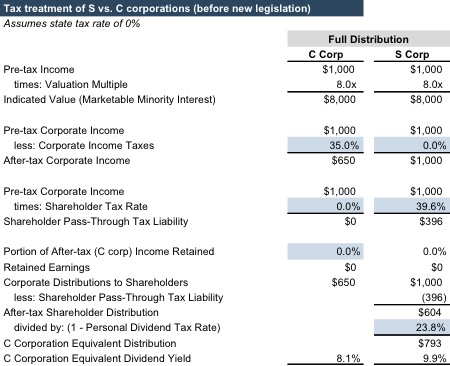
Before the Trump Tax Bill, it often made sense to structure investment management firms as tax pass through entities – usually S corporations or LLCs.  As shown in the table below, given taxable income of, say, $1 million, a C corporation would only have $650 thousand to distribute after paying federal corporate taxes at a rate of 35%.  Even though the same $1 million of taxable income would be taxed at a higher personal rate for S corporation shareholders, the after-tax distribution of $604 thousand would have a higher economic value when you consider S corp shareholders skip the dividend tax (paid at 23.8%) that would accrue to the C corporation shareholder.  After grossing up the after-tax dividend to the S corp shareholder at the C corporation dividend tax rate, the S corporation shareholder earns a C corporation equivalent dividend of nearly $800 thousand.  Assuming the RIA in this example is valued at 8x pre-tax income, the S corp shareholder experiences a distribution yield that is 180 basis points higher than if his or her RIA were structured as a C (all else equal).
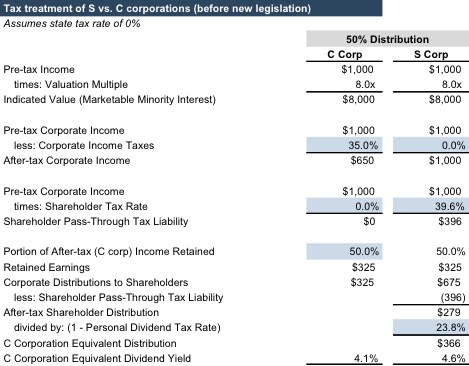
The example above assumes a fully distributing RIA, since many if not most RIA clients we’ve encountered over the years dividend out something close to 100% of their net income.  But the S corporation yield advantage also exists if, say, an RIA only distributes half of the C corp equivalent after-tax income (or, conversely, retains half of net income).
Tax Cuts and Jobs Act Mutes S Corp Advantage

The new tax legislation has a big impact on C corporation taxes, a more modest impact on personal income taxes, and no effect on capital gains taxes.  As a consequence, the economic advantage of organizing as an S corporation or LLC has been whittled away to almost nothing in some cases, and is arguably disadvantageous in other cases.

The table below depicts the comparative consequences of the new tax bill on RIAs organized as C corporations and S corporations.  For C corporations, the fourteen percentage point drop in corporate tax rates improves the after tax income available for distribution considerably.  In our example, a fully distributing C corporation with $1 million in pre-tax income would have $790 thousand in after-tax income to distribute to shareholders – a substantial improvement over the $650 thousand available under the old tax rates.
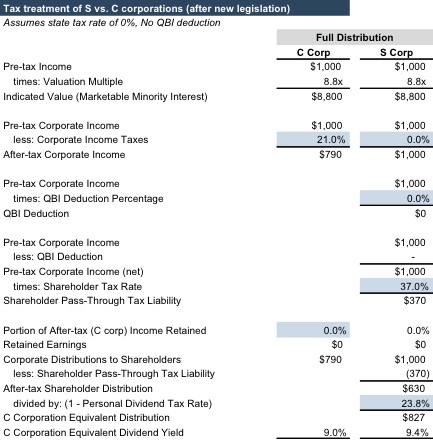
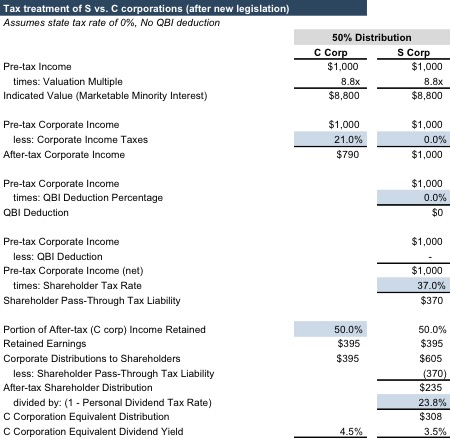
For S corporations and LLCs, however, the taxes on pass-through income are still substantial, as the after-tax distribution only improves from $604 thousand to $630 thousand (yes, it still improves).  If you gross this up for taxes that would be owed on the C corporation dividend, you arrive at a C corporation equivalent dividend of $827 thousand, or not much more than the $790 thousand dividend available for the C corporation.  The dividend yield advantage narrows from 180 basis points before the tax legislation to 40 basis points after the tax legislation (assuming some improvement in the valuation multiple – as discussed in last week’s blogpost). The comparison is even worse for investment management firms structured as tax pass-through entities but don’t distribute all of their net income.  Going back to the example of the firms that distribute half of their after tax earnings (on a C corp equivalent basis), the dividend yield for the C corporation improves under the new legislation from 4.1% to 4.5%, even with a higher valuation.  The S corp yield drops, however, assuming the same earnings retention as the C, from 4.6% to 3.5%, notably lower than the dollar amount and percentage distribution yield for the C corporation.
(Probably) No QBI Deduction for You

Knowing that they were trimming back the S corporation advantage, the tax bill introduced a new concept, the Qualified Business Income deduction, that allows certain S shareholders to deduct 20% of their pass-through income and, therefore, maintain more of the S corporation differential in tax rates.  However, in a very interesting and possibly more revealing move, the QBI deduction is NOT available for investment management firms.

Congress decided to exclude certain “specified service trade or business” income from qualifying for the deduction.  One excluded business is investment management: “The term ‘specified trade or business’ means any trade or business – (B) which involves the performance of services that consist of investing and investment management, trading, or dealing in securities (as defined in section 475(c)(2)), partnership interests, or commodities (as defined in section 475(e)(2)).”  Of note, Congress had never, to our knowledge,  previously singled out investment management for specific treatment as a “specified service trade or business.”  Like the limitation on the deductibility of financial planning fees mentioned last week, it appears this administration is taking aim at the RIA community (while inexplicably allowing QBI deductions for architects and engineers).

Despite the exclusion, the QBI deduction remains available to RIA shareholders for whom total income is less than $315 thousand; the deduction phases out until it is completely unavailable at incomes greater than $415 thousand.  As a result, many RIA shareholders will not get the benefit of the Qualified Business Income deduction.

Final Thoughts and Parting Shots

So, like the Mustang II, the tax bill is new but not necessarily improved for owners of RIAs structured as S corporations or LLCs (excluding the impact of generally higher AUM balances discussed in last week’s post).  The Trump administration didn’t aim its product at the investment management community any more than Ford was looking after driving enthusiasts in the early 1970s.  It could be worse, though.  In the mid-1980s Ford tried to ruin the Mustang’s reputation again with a version that was also underpowered and, this time, front wheel drive.  Mustang fans balked, and Ford released the car as an entirely separate product: the Probe, a name that may suggest how some RIA partners feel about the new tax law after they file their 2018 return.

ford_probe_1988_20180202.jpg

1988 Ford Probe: You know the marketing folks in Dearborn loved working with that name (photo: favcars.com)

Continue Reading

What a Cold Snap Teaches Us About Cycles in RIA M&A

Seasonal Market Metaphors

While frigid temperatures disrupted travel and infrastructure across the country, the RIA M&A market has remained anything but frozen. Deal activity continues at historically strong levels, reminding firms that favorable conditions are best used to prepare for the inevitable shifts that come with market cycles.
January 2026 | Making Buy-Sell Agreements Work: Valuation Mechanisms and Drafting Pitfalls
Value Matters® January 2026

Making Buy-Sell Agreements Work: Valuation Mechanisms and Drafting Pitfalls

Executive SummaryBuy-sell agreements are a cornerstone of planning for closely held businesses and family enterprises. Advisors spend significant time addressing ownership transitions, funding mechanisms, and tax considerations. Yet despite their importance, valuation provisions in buy-sell agreements are often treated as secondary drafting issues. Too often, they are boilerplate clauses that receive far less scrutiny than they deserve. When buy-sell agreements fail, valuation provisions are often the root cause.This article is the first in a two-part series examining how buy-sell agreements function in practice and why so many fall short of their intended purpose. Part I focuses on the valuation mechanisms commonly used in buy-sell agreements – fixed price, formula pricing, and appraisal-based processes – and explains the structural weaknesses that often undermine them. Drawing on our extensive valuation experience, we offer a practical framework for designing valuation provisions that are more likely to produce fair, predictable, and workable outcomes when a triggering event occurs.Part II will address what is required for buy-sell agreement pricing to be used to fix the value for gift and estate tax matters, including the requirements of Internal Revenue Code §2703 and guidance from key court cases such as Estate of Huffman and Connelly. Together, these articles are intended to help estate planners move beyond theoretical drafting and toward buy-sell agreements that withstand both real-world and IRS scrutiny.Common Buy-Sell Valuation MechanismsMost buy-sell agreements fall into one of four categories based on how price is determined:Fixed priceFormula pricingMultiple appraiser processSingle appraiser processEach approach has perceived advantages, but each also carries structural weaknesses that estate planners should carefully evaluate.Fixed-Price AgreementsFixed-price buy-sell agreements establish a specific dollar value for the business or ownership interests based on the owners’ agreement at a point in time. Their appeal lies in simplicity. The price is clear, easily understood, and inexpensive to administer. In theory, fixed-price agreements encourage owners to revisit and reaffirm value periodically.In practice, however, fixed prices are rarely updated with sufficient frequency. As the business evolves, the fixed price may become materially understated, overstated, or – by coincidence – approximately correct. The fundamental problem is not the use of a fixed price, but the absence of a reliable and consistently followed process for updating it. When the price becomes stale, incentives become misaligned. An unrealistically low price benefits the remaining owners, while an inflated price benefits the exiting owner. These distortions undermine fairness and often surface only after a triggering event, when renegotiation is least likely to succeed.Formula Price AgreementsFormula pricing agreements determine value by applying a predefined calculation, often based on financial statement metrics such as EBITDA multiples, book value, or shareholders’ equity. These agreements are frequently viewed as more objective than fixed prices and are attractive because they appear to adjust automatically as financial results change.The perceived precision of formulas is often illusory. Over time, changes in the business model, capital structure, accounting practices, or industry conditions can render a once-reasonable formula obsolete. Even when formulas are recalculated mechanically, they may fail to reflect economic reality (book value as a formula is a prime example of this). More importantly, most formula agreements lack guidance on when or how the formula itself should be revisited. Without periodic reassessment, formula pricing can embed significant inequities into the agreement while giving shareholders a false sense of certainty of fairness. Formula price agreements also fail to account for any non-operating assets that may have accumulated on the balance sheet. Valuation Process AgreementsValuation process agreements defer the determination of price until a triggering event occurs and rely on professional appraisers to establish value at that time. These agreements generally fall into two categories: multiple appraiser processes and single appraiser processes.Multiple Appraiser ProcessUnder a multiple appraiser process, each side appoints its own appraiser to value the business following a triggering event. If the resulting valuations differ beyond a specified threshold, the agreement typically calls for the appointment of a third appraiser to resolve the difference or render a binding conclusion.While this approach is intended to ensure fairness through balanced input, it often introduces uncertainty, delay, and cost. The final price, timing, and expense of the process are unknown at the outset. In addition, even well-intentioned appraisers may be perceived as advocates for the parties who selected them, complicating negotiations and eroding confidence in the outcome. For family-owned businesses in particular, the multiple appraiser process can unintentionally escalate conflict at a sensitive moment.Single Appraiser ProcessUnder a single appraiser process, one valuation firm is designated, either in advance or at the time of a triggering event, to perform a valuation. This approach is generally more efficient and cost-effective and avoids dueling opinions. When valuations are performed periodically, it can also make outcomes more predictable well before a triggering event occurs. Its effectiveness, however, depends entirely on careful advance planning and drafting.A More Effective Framework: “Single Appraiser: Select Now, Value Now and Annually (or Periodically) Thereafter”Given the shortcomings of traditional valuation mechanisms, is it possible to design a buy-sell valuation process that reliably produces reasonable outcomes? We believe it is.Based on extensive buy-sell agreement related valuation experience, we recommend a framework built on three principles: selecting the appraiser in advance, exercising the valuation process before a triggering event, and careful drafting of the valuation language in the agreement. 1. Retain an Appraiser NowEstate planners and other attorneys who draft buy-sell agreements should encourage clients to retain a qualified business appraiser at the outset, rather than waiting for a triggering event. Conducting an initial valuation transforms abstract agreement language into a concrete report that shareholders can review, understand, and question. This process reveals ambiguities in the agreement, clarifies expectations, and allows revisions to be made when no party knows whether they will ultimately be a buyer or a seller.This “Single Appraiser: Select Now, Value Now and Annually (or Periodically) Thereafter” approach offers several advantages:The valuation process is known and observed in advanceThe appraiser’s independence is established before any economic conflict arisesValuation methodologies and assumptions are understood by all partiesThe initial valuation becomes the operative price until updated or conditions changeAmbiguities in valuation language are identified and corrected earlyFuture valuations are more efficient, consistent, and less contentious2. Update the Valuation Annually or PeriodicallyStatic valuation mechanisms do not work in a dynamic business environment. Annual or periodic valuation updates help align expectations and reduce the likelihood of surprise or dissatisfaction when a triggering event occurs. In practice, disputes are more often driven by unmet expectations than by the absolute level of value. Regular valuations promote transparency and reduce friction.3. Draft Precise Valuation LanguageEven the best valuation process can fail if the agreement lacks clarity. Attorneys drafting buy-sell agreements should ensure that the agreements address, at a minimum:Standard of value (e.g., fair market value vs. fair value)Level of value (enterprise vs. interest level; treatment of discounts)Valuation date (“as of” date)Funding mechanismAppraiser qualifications (making certain to use business appraiser qualifications. For example, a “certified appraiser” refers to a real estate appraiser, rather than a business valuation expert.) Applicable appraisal standardsAmbiguity on any of these points materially increases the risk of divergent interpretations and unsuccessful outcomes.ConclusionBuy-sell agreements fail not because valuation is inherently subjective, but because valuation provisions are often left ambiguous, untested, or static. Estate planners and other attorneys who draft buy-sell agreements play a critical role in preventing these failures. By selecting appraisers in advance, exercising valuation processes periodically, and carefully drafting valuation language, advisors can dramatically improve the likelihood that a buy-sell agreement will function as intended.When valuation mechanisms are designed with the same rigor as tax and estate plans, buy-sell agreements can become durable planning tools capable of delivering predictability, fairness, and continuity when they are needed most. And the buy-sell agreement pricing may even be able to be used to fix the value for gift and estate tax filings. We will discuss this in Part II.For advisors who want to delve deeper into valuation concepts, planning strategies, and practical applications in estate and business succession planning, we recommend Buy-Sell Agreements: Valuation Handbook for Attorneys by Z. Christopher Mercer, FASA, CFA, ABAR (American Bar Association), written by our firm’s founder and Chairman. This book offers a thorough treatment of valuation issues and provides example language for consideration by attorneys when drafting buy-sell agreements that contain language important to the valuation process.
RIA M&A Update: Q4 2025
M&A activity in the RIA industry remained elevated through the end of 2025, capping a year defined by historically strong deal volume. While monthly deal counts in the fourth quarter moderated from the record-setting pace observed earlier in the year, overall activity remained well ahead of prior-year levels.

Cart

Your cart is empty