Corporate Valuation, Investment Management

May 25, 2021

Post-Pandemic Tax Planning for RIAs

Is It Time To Consider a Change in Your Corporate Structure, or Your Address?

Most of our colleagues at Mercer Capital live in Texas or Tennessee – two states with very low tax burdens. This is not by design so much as by circumstance: our firm grew up where we already lived. Until recently, the relatively low cost of living, short commutes, and moderate climate came with a tradeoff: most of our clients are on the coasts, so regular travel away from home was a necessity.

Now that the pandemic has made geographic proximity for many meetings a non-issue, we’re beginning to wonder how many of our clients are ultimately going to join us. Dynasty’s move from New York to Florida and UBS’s relocation to Tennessee got plenty of attention. And we’re starting to hear of smaller RIAs contemplating similar moves. This isn’t a crowded trade yet though; most investment management firms still call high-cost, high-tax states home.
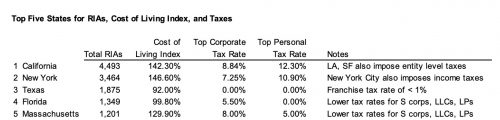
Texas and Florida have been climbing the rankings of states with the most RIAs, but two states still dominate this survey – New York and California. New York’s position is even stronger if you include adjacent communities of investment management firms in Connecticut, New Jersey, and Pennsylvania.

California is in an enviable position as the fifth largest economy on the globe, not to mention mostly-beautiful weather. That hasn’t been enough for Schwab, which has been migrating staff to Texas, Colorado, and Arizona for years. Now we’re starting to hear from California clients with staff members who moved out of state during the worst of the pandemic and would like to continue working remotely. When will their employers follow?

Manhattan is another story altogether, with city tax burdens layered on top of state taxes. With all due respect to Manhattan’s theme song, in the post-pandemic, remote-work world, if you can make it anywhere, why make it there? We have another wealth management client who just relocated from New York to Tennessee – cost structure and concern over the quality of life in Manhattan for the foreseeable future were key factors.

What the table above doesn’t show is the value of the talent pools already established in financial hubs like San Francisco and New York. But the relative cost of living may be enough to convince some of that talent to relocate. If that becomes a trend, all bets are off.

The wrong corporate structure can exacerbate the state tax differential. Imagine the extreme scenario of a Manhattan based C Corporation that considers moving to Florida and converting to an LLC.
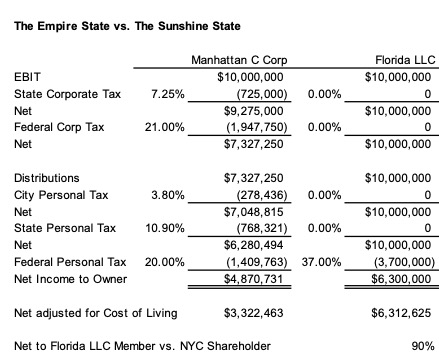
After-tax dividends/distributions to the Florida LLC member are about 30% higher than for a shareholder in a New York City C Corporation with the same EBIT (earnings before interest and taxes). But this differential is far greater if you consider the cost of living in Florida versus New York – a difference that will widen further if President Biden successfully rolls back some or all of the reduction in corporate taxes enacted in 2017.

As for proximity to clients, there are reasons to expect ultra-high net worth families in California and New York to relocate. Florida still has no estate tax, while New York just raised theirs. Tennessee and Texas (two states with no personal income tax) also have no estate tax, and Tennessee has strong and well-developed trust laws considered on-par with South Dakota.

Anecdotal experience supports this trend. Friends on the west coast and in the northeast have told me they have a recurring conversation with their neighbors that revolves around the question: “how much longer are you going to stay here?” The implication of this question is that, as soon as they could, they would decamp for a lower-tax, lower-cost of living part of the U.S. Just as the pandemic accelerated many trends, we expect to see a migration of wealthy clients to more cost-effective jurisdictions, as well as the firms that serve them.

Continue Reading

What a Cold Snap Teaches Us About Cycles in RIA M&A

Seasonal Market Metaphors

While frigid temperatures disrupted travel and infrastructure across the country, the RIA M&A market has remained anything but frozen. Deal activity continues at historically strong levels, reminding firms that favorable conditions are best used to prepare for the inevitable shifts that come with market cycles.
January 2026 | Making Buy-Sell Agreements Work: Valuation Mechanisms and Drafting Pitfalls
Value Matters® January 2026

Making Buy-Sell Agreements Work: Valuation Mechanisms and Drafting Pitfalls

Executive SummaryBuy-sell agreements are a cornerstone of planning for closely held businesses and family enterprises. Advisors spend significant time addressing ownership transitions, funding mechanisms, and tax considerations. Yet despite their importance, valuation provisions in buy-sell agreements are often treated as secondary drafting issues. Too often, they are boilerplate clauses that receive far less scrutiny than they deserve. When buy-sell agreements fail, valuation provisions are often the root cause.This article is the first in a two-part series examining how buy-sell agreements function in practice and why so many fall short of their intended purpose. Part I focuses on the valuation mechanisms commonly used in buy-sell agreements – fixed price, formula pricing, and appraisal-based processes – and explains the structural weaknesses that often undermine them. Drawing on our extensive valuation experience, we offer a practical framework for designing valuation provisions that are more likely to produce fair, predictable, and workable outcomes when a triggering event occurs.Part II will address what is required for buy-sell agreement pricing to be used to fix the value for gift and estate tax matters, including the requirements of Internal Revenue Code §2703 and guidance from key court cases such as Estate of Huffman and Connelly. Together, these articles are intended to help estate planners move beyond theoretical drafting and toward buy-sell agreements that withstand both real-world and IRS scrutiny.Common Buy-Sell Valuation MechanismsMost buy-sell agreements fall into one of four categories based on how price is determined:Fixed priceFormula pricingMultiple appraiser processSingle appraiser processEach approach has perceived advantages, but each also carries structural weaknesses that estate planners should carefully evaluate.Fixed-Price AgreementsFixed-price buy-sell agreements establish a specific dollar value for the business or ownership interests based on the owners’ agreement at a point in time. Their appeal lies in simplicity. The price is clear, easily understood, and inexpensive to administer. In theory, fixed-price agreements encourage owners to revisit and reaffirm value periodically.In practice, however, fixed prices are rarely updated with sufficient frequency. As the business evolves, the fixed price may become materially understated, overstated, or – by coincidence – approximately correct. The fundamental problem is not the use of a fixed price, but the absence of a reliable and consistently followed process for updating it. When the price becomes stale, incentives become misaligned. An unrealistically low price benefits the remaining owners, while an inflated price benefits the exiting owner. These distortions undermine fairness and often surface only after a triggering event, when renegotiation is least likely to succeed.Formula Price AgreementsFormula pricing agreements determine value by applying a predefined calculation, often based on financial statement metrics such as EBITDA multiples, book value, or shareholders’ equity. These agreements are frequently viewed as more objective than fixed prices and are attractive because they appear to adjust automatically as financial results change.The perceived precision of formulas is often illusory. Over time, changes in the business model, capital structure, accounting practices, or industry conditions can render a once-reasonable formula obsolete. Even when formulas are recalculated mechanically, they may fail to reflect economic reality (book value as a formula is a prime example of this). More importantly, most formula agreements lack guidance on when or how the formula itself should be revisited. Without periodic reassessment, formula pricing can embed significant inequities into the agreement while giving shareholders a false sense of certainty of fairness. Formula price agreements also fail to account for any non-operating assets that may have accumulated on the balance sheet. Valuation Process AgreementsValuation process agreements defer the determination of price until a triggering event occurs and rely on professional appraisers to establish value at that time. These agreements generally fall into two categories: multiple appraiser processes and single appraiser processes.Multiple Appraiser ProcessUnder a multiple appraiser process, each side appoints its own appraiser to value the business following a triggering event. If the resulting valuations differ beyond a specified threshold, the agreement typically calls for the appointment of a third appraiser to resolve the difference or render a binding conclusion.While this approach is intended to ensure fairness through balanced input, it often introduces uncertainty, delay, and cost. The final price, timing, and expense of the process are unknown at the outset. In addition, even well-intentioned appraisers may be perceived as advocates for the parties who selected them, complicating negotiations and eroding confidence in the outcome. For family-owned businesses in particular, the multiple appraiser process can unintentionally escalate conflict at a sensitive moment.Single Appraiser ProcessUnder a single appraiser process, one valuation firm is designated, either in advance or at the time of a triggering event, to perform a valuation. This approach is generally more efficient and cost-effective and avoids dueling opinions. When valuations are performed periodically, it can also make outcomes more predictable well before a triggering event occurs. Its effectiveness, however, depends entirely on careful advance planning and drafting.A More Effective Framework: “Single Appraiser: Select Now, Value Now and Annually (or Periodically) Thereafter”Given the shortcomings of traditional valuation mechanisms, is it possible to design a buy-sell valuation process that reliably produces reasonable outcomes? We believe it is.Based on extensive buy-sell agreement related valuation experience, we recommend a framework built on three principles: selecting the appraiser in advance, exercising the valuation process before a triggering event, and careful drafting of the valuation language in the agreement. 1. Retain an Appraiser NowEstate planners and other attorneys who draft buy-sell agreements should encourage clients to retain a qualified business appraiser at the outset, rather than waiting for a triggering event. Conducting an initial valuation transforms abstract agreement language into a concrete report that shareholders can review, understand, and question. This process reveals ambiguities in the agreement, clarifies expectations, and allows revisions to be made when no party knows whether they will ultimately be a buyer or a seller.This “Single Appraiser: Select Now, Value Now and Annually (or Periodically) Thereafter” approach offers several advantages:The valuation process is known and observed in advanceThe appraiser’s independence is established before any economic conflict arisesValuation methodologies and assumptions are understood by all partiesThe initial valuation becomes the operative price until updated or conditions changeAmbiguities in valuation language are identified and corrected earlyFuture valuations are more efficient, consistent, and less contentious2. Update the Valuation Annually or PeriodicallyStatic valuation mechanisms do not work in a dynamic business environment. Annual or periodic valuation updates help align expectations and reduce the likelihood of surprise or dissatisfaction when a triggering event occurs. In practice, disputes are more often driven by unmet expectations than by the absolute level of value. Regular valuations promote transparency and reduce friction.3. Draft Precise Valuation LanguageEven the best valuation process can fail if the agreement lacks clarity. Attorneys drafting buy-sell agreements should ensure that the agreements address, at a minimum:Standard of value (e.g., fair market value vs. fair value)Level of value (enterprise vs. interest level; treatment of discounts)Valuation date (“as of” date)Funding mechanismAppraiser qualifications (making certain to use business appraiser qualifications. For example, a “certified appraiser” refers to a real estate appraiser, rather than a business valuation expert.) Applicable appraisal standardsAmbiguity on any of these points materially increases the risk of divergent interpretations and unsuccessful outcomes.ConclusionBuy-sell agreements fail not because valuation is inherently subjective, but because valuation provisions are often left ambiguous, untested, or static. Estate planners and other attorneys who draft buy-sell agreements play a critical role in preventing these failures. By selecting appraisers in advance, exercising valuation processes periodically, and carefully drafting valuation language, advisors can dramatically improve the likelihood that a buy-sell agreement will function as intended.When valuation mechanisms are designed with the same rigor as tax and estate plans, buy-sell agreements can become durable planning tools capable of delivering predictability, fairness, and continuity when they are needed most. And the buy-sell agreement pricing may even be able to be used to fix the value for gift and estate tax filings. We will discuss this in Part II.For advisors who want to delve deeper into valuation concepts, planning strategies, and practical applications in estate and business succession planning, we recommend Buy-Sell Agreements: Valuation Handbook for Attorneys by Z. Christopher Mercer, FASA, CFA, ABAR (American Bar Association), written by our firm’s founder and Chairman. This book offers a thorough treatment of valuation issues and provides example language for consideration by attorneys when drafting buy-sell agreements that contain language important to the valuation process.
RIA M&A Update: Q4 2025
M&A activity in the RIA industry remained elevated through the end of 2025, capping a year defined by historically strong deal volume. While monthly deal counts in the fourth quarter moderated from the record-setting pace observed earlier in the year, overall activity remained well ahead of prior-year levels.

Cart

Your cart is empty